
737-200 Looses Engine at CPT (Pictures)

A Nationwide Airlines Boeing 737-230 carrying 106 passengers made an emergency landing at Cape Town International Airport (South Africa) on Wednesday afternoon after the right engine (Pratt & Whitney JT8D-15) fell off during takeoff.

Flight CE723, which had been bound for Johannesburg, touched down safely after airport fire and rescue services cleared the debris from the runway.
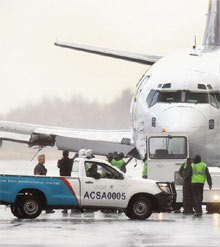
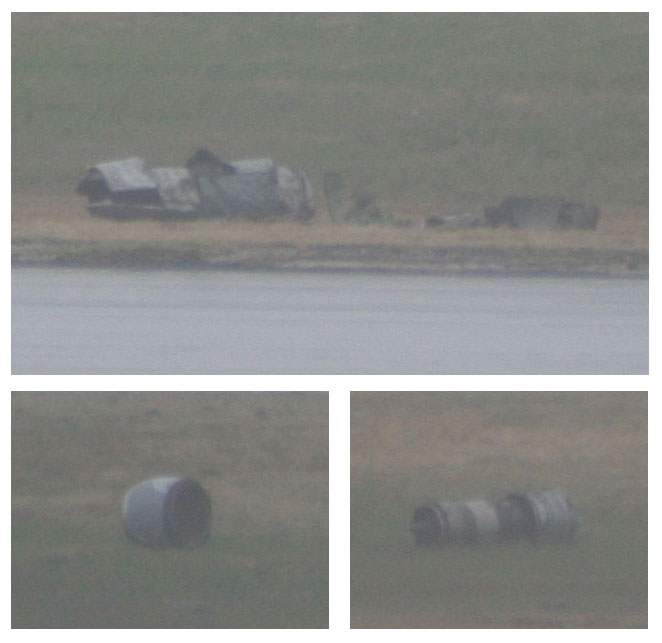
Nationwide Airlines Boeing 737-230 - Lost Engine
Credits: AvCom / Kremlin

The airline said in a press release that Flight CE723 departed from Cape Town (CPT) on schedule at 15:50. At take-off it was reported that the right hand engine separated from the wing. The aircraft continued to climb out. The aircraft returned and landed at Cape Town International Airport without further incident. No passengers or crew were injured.

One of the passengers told she had been in a seat directly over the wing.
As the plane took off, the man next to her, in the window seat, was looking out of the window.
“I heard this huge bang, and he said ‘that’s our engine that’s just fallen off’. I couldn’t believe it. He had to repeat it to me,” she said. … Continue at News24.com
A380 world tour continues with the first visit to Montreal

The Airbus A380 will continue its world tour with a visit to Montréal-Pierre Elliott Trudeau International Airport – in Quebec (Canada), on 12th November 2007.

The world’s largest commercial airliner, which is also the most technically advanced and environmentally friendly civil aircraft in the skies will be operated jointly, under Airbus’ responsibility, by Airbus and Air France flight and cabin crew.

The aircraft used for the trip is the development aircraft A380 MSN007 (Manufacturer’s Serial Number), powered by four Rolls-Royce Trent 900 engines. MSN007 is equipped with an Airbus-designed, full passenger cabin, which demonstrates how the airplane can comfortably carry up to 519 passengers in an extra-quiet and relaxing three-class cabin environment.

The A380 has already visited more than 60 airports, easily fitting into each environment and demonstrating its smooth and efficient compatibility. The Montréal airport meets the design criteria for the operation of new large aircraft.

As part of the A380 World Tour 2007, MSN007 will leave Montreal on 13th November to go to Orlando International Airport in Florida (United States). It is scheduled to return to Montreal on 15th November, continuing to Paris – Charles de Gaulle on the same day, and then back to its Toulouse base.

Reflecting the market success of the A380, Airbus has already received 189 orders and commitments from 16 customers. First operator, Singapore Airlines, has begun scheduled operations between Singapore and Sydney on 28th October.

Boeing Completes 747-8 Intercontinental Firm Configuration

The Boeing Company has completed firm configuration of the 747-8 Intercontinental. This milestone marks the completion of the major trade studies needed to finalize the airplane’s performance and interior features.
“We have designed the 747-8 Intercontinental to be the ideal airplane for serving the 400- to 500-seat market between the 777 and the A380,” said Michael Teal, deputy chief project engineer for the 747 program. “The airplane will provide airlines significantly lower operating costs, as well as improved economics and environmental performance compared to the 747-400. It also will feature a new interior that will increase passenger appeal and create a strong and very favorable first impression.”
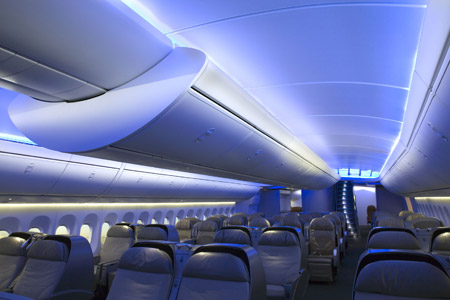
Many of the trade studies for the 747-8 Intercontinental focused on the airplane’s interior. The airplane will incorporate interior features from the 787 Dreamliner, including a new curved, upswept architecture that will give passengers a greater feeling of space and comfort, while adding more room for personal belongings. The enhanced interior architecture is accentuated by new lighting technology that creates a perception of airy brightness and provides smooth lighting transitions to offer a more restful environment.

Boeing 747-8 Intercontinental Interior

The 747-8 also will integrate features from the 777, including windows that equal those on the 777 (15.3 inches/38.8 centimeters tall and 10.76 inches/27.3 centimeters wide), and are larger than those on the 747-400.
“The 747 family’s unique interior and structural design have provided passengers with memorable flying experiences for decades,” said Doug Ackerman, engineering interior team leader for the 747-8. “With the newly applied 787 features, passengers will know they are on a brand new airplane the moment they step on board, and enjoy a more relaxing flying experience.”

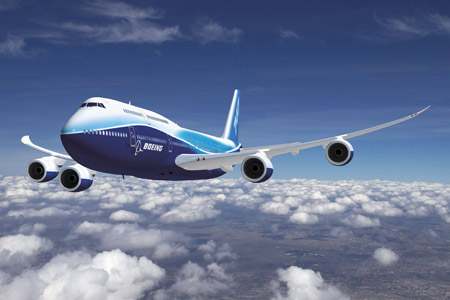
Boeing 747-8 Intercontinental

As for the airplane’s performance, the 747-8 Intercontinental will be stretched 5.6m (18.3ft) from the 747-400 to provide 467 seats in a three-class configuration and approximately 14,815-km (8,000-nmi) in range. It will provide nearly equivalent trip costs to those on the 747-400 and 10 percent lower seat-mile costs, plus 28 percent greater cargo volume. The 747-8 Intercontinental also will be 16 percent more fuel efficient and 30 percent quieter than its predecessor.
With firm configuration complete, Boeing and its suppliers can begin detailed design of parts, assemblies and other systems for the 747-8 Intercontinental. The detailed designs will then be released to Boeing suppliers and factories to begin production of the airplane.
“This milestone is a tribute to the efforts of the 747-8 team, our customers and suppliers,” said Teal. “Now our team and partners must concentrate on completing the detailed designs needed to begin production and deliver the airplane on schedule in late 2010.”
The 747-8 program, which includes the 747-8 Intercontinental and the 747-8 Freighter, was launched in November 2005 by Cargolux Airlines and Nippon Cargo Airlines. Lufthansa was the first airline to order the 747-8 Intercontinental in December 2006.

FAA Report – 11/6/2007


Date & Time: 11/05/2007 15:28
Location: Boston, MA
Aircraft Type: Airbus A319-112 Registration: N703UW
Airline: US Airways Flight: 2022
Phase: Unknown
Damage: None
Injuries & Fatalities: 5 unknown injuries
Description: N703UW, US Airways flight 2022, advised that 5 crew members were feeling ill from a sulfur smell they encountered on a previous flight and transported to the hospital with unknown injuries

Video – Sikorsky Piasecki X-49A Speedhawk Test Flight

This Sikorsky Piasecki X-49A “Speedhawk” flight test video has emerged on YouTube. Piasecki Aircraft is near the end of its initial test run of the X-49A vectored thrust-ducted propeller (VDTP) compound helicopter, a modified Sikorsky H-60. By late October the Sikorsky Piasecki X-49A “Speedhawk” did 24 test flights with a total of 19 hours flight time. [Source]

Link: More information about the Sikorsky Piasecki X-49A Speedhawk

It will be interesting to see if and how the US Army will use this strange ugly bird. Maybe it will be used for some MEDEVAC missions. It will be difficult to fly for sure, with this heavy propeller engine mounted on its tail.

LAN Airlines Complete Deal for 32 787s and 4 777 Freighters

Boeing announced that Chile’s LAN Airlines will receive 32 787 Dreamliners, marking the largest 787 acquisition to date for Latin America. The Santiago-based carrier has ordered 26 airplanes from Boeing, and will lease an additional six 787-9s from International Lease Finance Corp.
In addition to the Dreamliner order, Boeing said LAN also has committed to acquiring four 777 Freighters – two from Boeing and two to be leased from GE Commercial Aviation Services (GECAS).

Lan Chile Boeing 787 Dreamliner and 777-200LR Freighter

The order for 26 Dreamliners, consisting of a mix of 787-8s and 787-9s, is worth approximately $ 4.5 billion at published list prices. The two 777 Freighters are similarly valued at approximately $ 500 million. The two direct-purchase 777 Freighters were previously attributed to an unidentified customer on Boeing’s orders and deliveries Web site.
“This order reaffirms support for Boeing’s Dreamliner from the largest and one of the most profitable airlines in Latin America,” said John Wojick, Boeing Commercial Airplanes vice president, Sales, Latin America and the Caribbean. “With the 787, LAN will be able to provide its passengers with the very best in long-range air travel, including larger windows, higher cabin humidity, more space and a lower cabin altitude.
“In addition, LAN’s long-haul cargo operations will gain unmatched efficiency with the 777 Freighter, which offers more capacity and greater range than any other twin-engine freighter,” Wojick said.
Thus far, two other Latin American carriers have committed to the 787 Dreamliner: Aeromexico, with three leased, two purchased, and Colombia’s Avianca, which has ordered 10.
The Boeing 787 Dreamliner, scheduled for entry into service in 2008. Thus far, 51 airlines have logged 736 orders, making the Dreamliner the most successful commercial airplane launch in history.
The 777 Freighter is the sixth and newest member of the 777 family of airplanes and builds upon the family’s extensive use of advanced technologies. The 777 Freighter is based on the 777-200LR passenger model and is designed to facilitate easy interlining with the Boeing 747 freighter fleet. Eleven customers have ordered 82 777 Freighters, which are scheduled to enter service beginning in the fourth quarter of 2008.

FAA Report – 11/5/2007

Date & Time: 11/02/2007 11:47
Location: Wichita, KS
Aircraft Type: McDonnell Douglas DC-8-71(F) Registration: N/A
Airline: United Parcel Service – UPS
Phase: Cruise
Damage: Unknown
Injuries & Fatalities: 0
Description: UPS flight 918 declared an emergency and diverted to Wichita – Mid-Continent (ICT / KICT) due to fire in the lavatory. Aircraft landed without incident.

Preliminary Investigation Report – SAS DHC8-Q400 LN-RDI Accident

Denmark’s Accident Investigation Board reported that the landing gear accident of SAS Dash 8 – Q400 LN-RDI at 27.10.2007 in Copenhagen was caused by a piece of rubber O-Ring trapped in the landing gear, preventing it from extending accurately.
This cause is not related to the two previous accidents which occurred in September 2007. According to the preliminary investigation report, this accident might have happened because of a fault by maintenance personnel and not because of a possible design fault of Bombardier’s Q400.

Summary
During the examination of the retraction/extension actuator assembly from the right main landing gear of the occurrence aircraft, an O-Ring was found blocking the orifice in the restrictor valve.
The blocked orifice within the actuator assembly prevented the normal extension of the right main landing gear.
The O-Ring was similar to that O-Ring for the door solenoid sequence valve (SSV). The only component in the landing gear system that incorporated this O-Ring was the SSV.
An SSV on the right main landing gear system had been replaced on 16 October 2007.
In the past occurrences, O-Rings (situated adjacent to the filter) from the SSV´s are not known to have migrated into the landing gear hydraulic system.
The O-ring found blocking the right main landing gear actuator restrictor valve, was from the SSV that was previously installed on the occurrence aircraft.
The rogue O-Ring could not have traveled from the SSV to its final location in the right main landing gear retraction/extension actuator restrictor valve.
The MSV of the right main landing gear was replaced on 22 October 2007.
According to the maintenance records, the replacement MSV, was initially configured for installation into the nose landing gear hydraulic system. Prior to installation on the occurrence aircraft, the supplied MSV was reconfigured by maintenance personnel. To make it compatible with the installation requirements for the main landing gear, the unions from the replaced MSV were used.
During the replacement of the MSV, the rogue O-Ring could have unknowingly been transferred from one side of the MSV to the other side by maintenance personnel.
Following a possible transfer of the O-Ring, it could travel through the hydraulic lines towards the main landing gear retraction/extension actuator restrictor valve causing the blockage of the valve.

Source:
Preliminary Investigation Report PDF
Technical drawing

Video – Japanese F-2 Crash during Takeoff

This Japanese F-2 fighter jet burst into flames just after takeoff in Nagoya, central Japan, on 31 October, but its two pilots managed to escape with minor injuries.
The plane was about to start its first test flight since it was docked for regular check-ups at the domestic airport of Nagoya.
It nosedived immediately after takeoff at the airport and glided on its tail over the runway before swerving off into the grass.

“We failed on takeoff and the fuselage plunged almost vertically from a height of 50 meters,” one of the pilots said.
The cause of the accident is not known yet.