Safety Report – 08/31/2009


Date: 08/29/2009 23:51
Location: Charlotte, NC
Aircraft Type: McDonnell Douglas MD-88 Registration: N974DL
Operator: Delta Air Lines Flight: 1606
Phase: Landing
Level of Damage: Unknown
Injuries & Fatalities: None
Description: On landing, the landing gear door was extended and made contact with the pavement during rollout

Date: 08/27/2009 20:03
Location: Tampa, FL
Aircraft Type: Boeing 717-200 Registration: Unknown
Operator: Airtran Airways Flight: TRS163
Phase: Unknown
Level of Damage: None
Injuries & Fatalities: 1 injured crew member
Description: The flight encountered turbulence and one flight crew member sustained a broken ankle – 60 Miles from Tampa, FL

Source: FAA
Correctness of this posting is not guaranteed & completeness not intended. This posting is just for informational purpose.

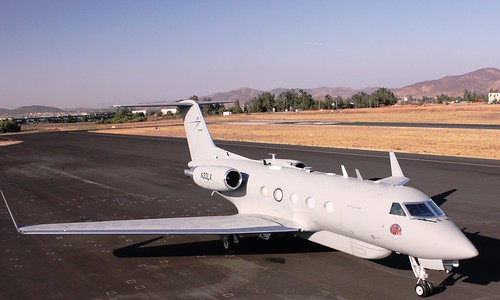
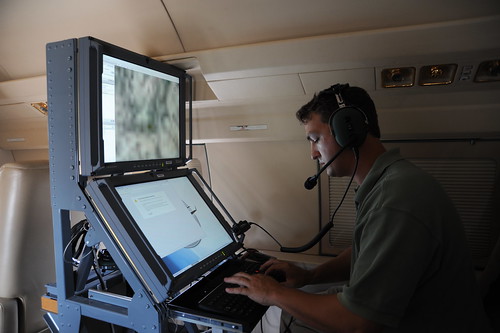
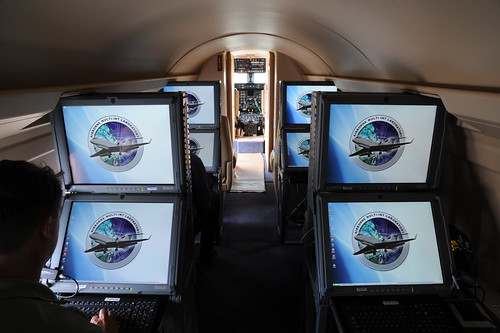
Photos – Inside the Lockheed Martin Airborne Multi-Intelligence Laboratory (AML)

Lockheed Martin recently released photos showing the inside of their new Airborne Multi-Intelligence Laboratory (AML). The Lockheed Martin AML is based on the Gulfstream III business jet and will be used “to tailor advanced sensor combinations to resolve specific military, strategic intelligence and homeland security mission needs.”

The plane features a computing capability that supports most commercial operating systems, a radome on the belly of the aircraft with ample volume for a range of sensors, and four workstations. In addition, the AML can process data both onboard and on the ground to accommodate a variety of experiments. While the AML is equipped with a robust suite of sensors as well as wideband and narrowband data links, the intent is to rotate sensors as necessary to answer specific requirements. To achieve that goal, the AML incorporates an easily reconfigurable architecture designed to allow different sensors and equipment to be rapidly integrated into the aircraft’s mission systems.

The airborne test bed received its Experimental Airworthiness Certificate from the Federal Aviation Administration (FAA) on Wednesday.

Photos via Flickr
Source: Lockheed Martin

787 First Flight Scheduled for End of 2009

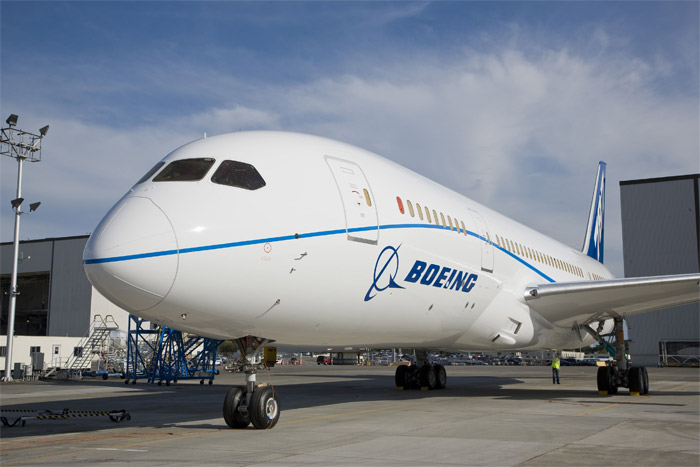
Boeing today announced an update to the Boeing 787 Dreamliner program. According to the planemaker, the first flight of the 787 Dreamliner is expected by the end of 2009 and first delivery is expected to occur in the fourth quarter of 2010.

The new schedule reflects the previously announced need to reinforce an area within the side-of-body section of the aircraft, along with the addition of several weeks of schedule margin to reduce flight test and certification risk. The company projects achieving a production rate of 10 airplanes per month in late 2013.

Boeing 787 Dreamliner Painted in Special Livery

The 787 team working the side-of-body reinforcement has completed initial testing and is finalizing design details of new fittings that are expected to ensure full structural integrity of the joint. The static test procedure that uncovered the issue will be repeated and the results fully analyzed before first flight is conducted. Fatigue testing also will be performed on stringer components to validate the long-term durability of the modification.

The first 787 test airplane and static test unit have been prepared for the new fittings. Installation is expected to begin within the next few weeks.

Source: Boeing
Photo: Boeing

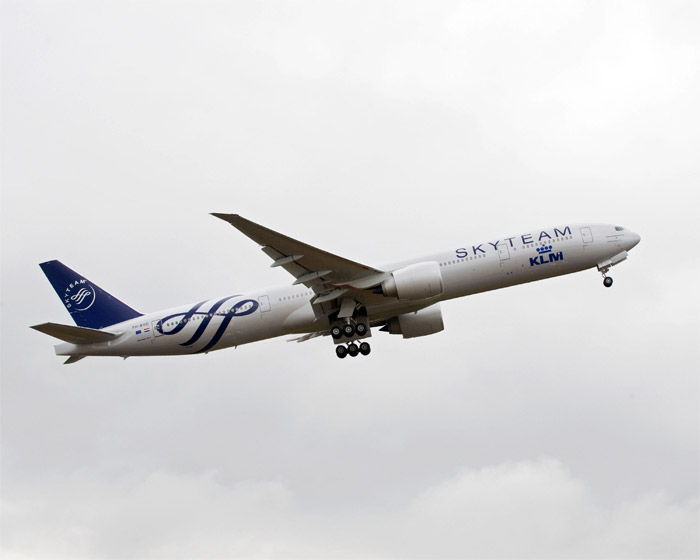
Photos – KLM 777-300ER in SkyTeam Livery

Boeing today delivered a 777-300ER (Extended Range) to KLM Royal Dutch Airlines (Reg: PH-BVD – Name: “Nationaal Park Amboseli”). The airplane has been painted in a special SkyTeam livery in celebration of the alliance’s 10th anniversary. Today’s delivery marks the start of an in-service evaluation using chrome-free decorative paint and primer.

KLM Royal Dutch Airlines Boeing 777-300ER in Special SkyTeam Livery
Photo: Boeing

More photos at Flickr:
http://www.flickr.com/photos/nustyr/3856519598/
http://www.flickr.com/photos/nustyr/3855729967/
http://www.flickr.com/photos/nustyr/3855729713/
http://www.flickr.com/photos/nustyr/3856520306/
http://www.flickr.com/photos/nustyr/3856520138/

As part of Boeing’s lifecycle approach to reducing environmental impact and in response to KLM’s and other customer’s requests, Boeing has introduced a chrome-free primer and chrome-free exterior decorative paint to this airplane. In addition to simplified health and safety monitoring requirements, a chrome-free primer reduces the environmental impact of the paint and stripping process. Removing chrome from the paint and primer eliminates the need for special handling of paint waste and clean-up and designated offsite disposal areas.

Boeing will apply the non-chrome paint and primer on up to 14 airplanes across Boeing models for in-service evaluation with the intention of making it a standard option in the future.

Source: Boeing

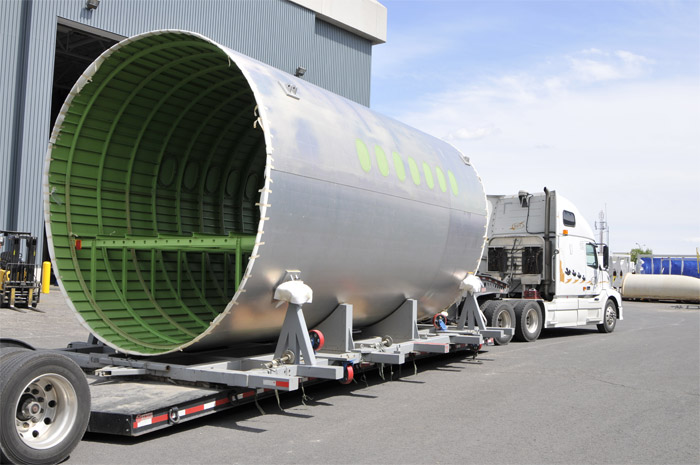
Photo – Bombardier CSeries Fuselage Test Barrel

The first test component, a fuselage test barrel, for the new CSeries single-aisle aircraft, has been delivered to Bombardier’s Saint-Laurent, Quebec facility. The test barrel is representative of the main fuselage section of the upcoming CSeries aircraft. Its production and testing will demonstrate the manufacturing and engineering structural concepts before the aircraft’s final design phase begins in 2010. The CSeries aircraft’s entry into service is scheduled for 2013.

Bombardier CSeries Fuselage

The test barrel, which measures approximately 23 feet (7 m) long and has a maximum diameter of approximately 12 feet (3.7 m), is made of advanced aluminum alloys. These materials have been selected to provide weight and maintenance advantages for CSeries jetliner operators.

Built by Shenyang Aircraft Corporation, a unit of China Aviation Industry, the test barrel left Dalian, China on July 20, 2009, traveled across the Pacific and then 2,500 miles from California to Quebec.

Over 10 per cent of the CSeries aircraft will be manufactured in China by Shenyang Aircraft Corporation. Shenyang also supplies the empennage, as well as the aft and forward fuselage sections for Bombardier’s Q400 turboprop airliner.

Bombardier’s 110-seat and 130-seat CSeries aircraft will benefit from the latest technological advancements, including: fourth generation aerodynamics; increased use of composites and advanced aluminium alloys in structures; a next-generation engine – the Pratt & Whitney PurePowerTM PW1000G engine; and the very latest in system technologies, such as fly-by-wire and electric brakes.

Photo: Bombardier
Source: Bombardier

Safety Report – 08/24/2009


Date: 08/21/2009 23:46
Location: Los Angeles, CA
Aircraft Type: Boeing 757-223 Registration: N663AM
Operator: American Airlines
Phase: Cruise
Level of Damage: Minor
Injuries & Fatalities: None
Description: The flight declared an emergency due to a right wing structural issue. The flight diverted to LAX and landed without incident. Post flight inspection revealed 5 FT of right wing trailing edge slat damaged.

Source: FAA
Correctness of this posting is not guaranteed & completeness not intended. This posting is just for informational purpose.

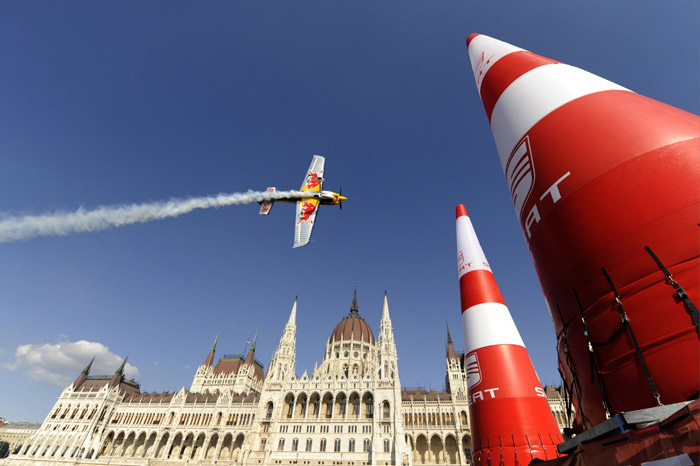
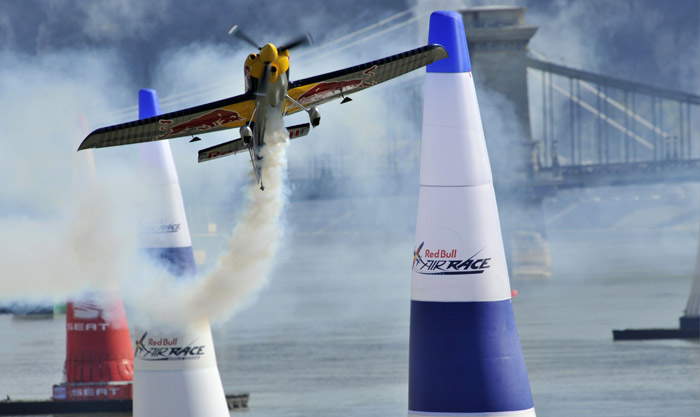
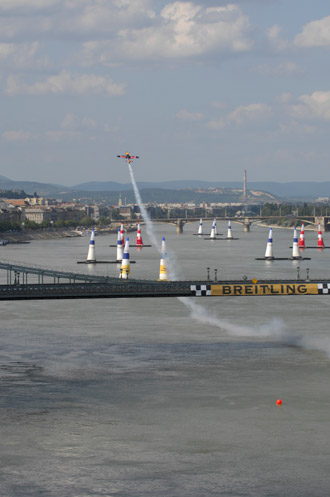
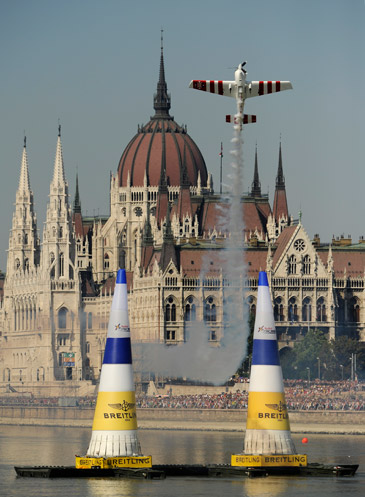
Photos – Red Bull Air Race Budapest

This week the 4th Red Bull Air Race of the 2009 season was taking place in Budapest (Hungary).

On Wednesday, American Kirby Chambliss upset championship leader Hannes Arch in Qualifying at 4th round, snatching one championship point away from the Austrian with the fastest time of the day. Australia’s rookie sensation Matt Hall got a career-best third while Arch’s main rival for the overall title, Britain’s Paul Bonhomme, fell to sixth place.

Today the American Michael Goulian won the thrill-filled final race, while Britain’s Paul Bonhomme grabbed second place and knocked Austrian Hannes Arch out of the championship lead in a thrilling battle over the Danube River in front of a national holiday crowd of 650,000. American Kirby Chambliss grabbed third place, which dropped Arch into fourth and off the podium for the first time in over a year. German rookie Matthias Dolderer took a career-best fifth place.

Photos

Red Bull Air Race 2009 Budapest Qualifying Peter Besenyei

Red Bull Air Race Budapest Qualifying Peter Besenyei 2009

Red Bull Air Race Budapest Flying under Bridge Red Bull Air Race Budapest Stunning Flight Action

Photos by Red Bull (Thanks!)

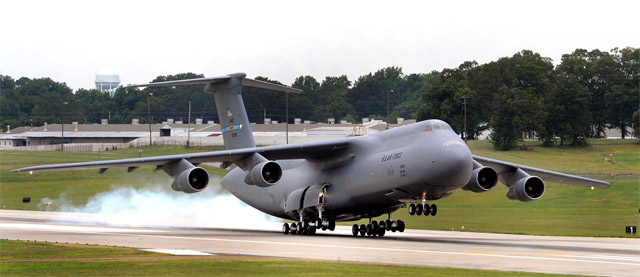
Lockheed Martin Begins C-5 RERP Production

Lockheed Martin announced that the first C-5 Galaxy was inducted into the Reliability Enhancement and Re-engining Program (RERP) production line. The RERP modifications consist of more than 70 improvements and upgrades to the C-5 airframe and aircraft systems, and include the installation of new higher-thrust, more reliable turbofan engines.

The C-5M is the product of a two-phase modernization effort. The first, the ongoing Avionics Modernization Program (AMP), provides the aircraft a state-of-the-art glass cockpit with modern avionics and flight instruments. Nearly half of the C-5 fleet has already undergone the AMP modifications. RERP is the second phase of the C-5 modernization effort.

USAF C-5 Galaxy Serial Number 83-1285

The first aircraft to enter the RERP production line is a C-5B based at Dover AFB, Del. This aircraft, Air Force serial number 83-1285, was the first C-5B to come off the production line in 1985. Modernization of this first aircraft is expected to take 13 months. At rate production, the conversion time on future C-5s is expected to be reduced to eight months.

The Super Galaxy climbs higher and faster than legacy C-5s while carrying more cargo over longer distances. It also requires less tanker support. The C-5M is projected to have a much higher mission availability rate due to increased reliability.

An Air Force aircrew based at Dover AFB, Del., recently demonstrated this improved capability by flying non-stop and unrefueled from Dover to Incirlik, Turkey, while carrying 90,000 pounds of cargo on 36 standard military cargo pallets. The crew was able to complete the round trip in two days versus the normal three, and they saved 30,000 pounds of fuel by eliminating an en-route stop.

Current Air Force plans call for Lockheed Martin to deliver 52 C-5Ms (modification of 49 C-5Bs, two C-5Cs, and one C-5A) by 2016. Three C-5Ms, the former Super Galaxy test fleet, have been redelivered to the Air Force. Two aircraft are currently based at Dover. The third C-5M is scheduled to come out of programmed depot maintenance in early September and will then be ferried to Dover where it will enter operation.

RERP Production Process Background

After the C-5 aircraft is inducted into the RERP assembly line and the fuel tanks are drained, removal of major systems and equipment, including the current GE TF39 turbofan engines will begin.

Work will then begin on the wing and empennage, wing slats, wing trailing edges, the fuel system, and installing the engine pylon attach fittings and the pylons themselves. This work will be followed by modifications to the cargo compartment, the flight station and landing gear. Also, aircraft systems, such as environmental control, will be reworked, while others, such as the auxiliary power units, will be replaced. The last stage of modifications includes removing wiring for the old systems and installing new wiring.

Finally, the GE F138-GE-100 turbofan engines will be installed. These engines, rated at 50,000 pounds of thrust, are the military version of the CF6-80C2 engine that has recorded millions of flight hours in commercial service. This is the same engine as on Air Force One. It is expected that the F138 engines will have a 20-year on-wing service life before overhaul on the C-5M.

The first production C-5M is scheduled for redelivery to Dover AFB in September 2010.

Photo: Lockheed Martin
Source: Lockheed Martin