
I’ll be off till the end of next week.
This means that I won’t post any new articles or approve new commentators during that time.
Just in case you wonder why this place isn’t updated as often as you’re used to! 😉
I’ll be off till the end of next week.
This means that I won’t post any new articles or approve new commentators during that time.
Just in case you wonder why this place isn’t updated as often as you’re used to! 😉
A joint U.S. Air Force and Lockheed Martin flight crew flying a C-5M Super Galaxy strategic transport claimed 41 world aeronautical records in one flight on September 13.
The flight from Dover AFB broke eight existing world marks and established standards in 33 other categories where there had been no previous record attempt. The records were set in the Class C-1.S, Jet category for altitude in horizontal flight, altitude with payload, time-to-climb, time-to-climb with payload and greatest payload to 2,000 meters. The aircraft carried a payload of more than 80,000 kg (the actual measured payload weight was 176,610 lb) to an altitude of more than 41,100 feet in 23 minutes, 59 seconds.
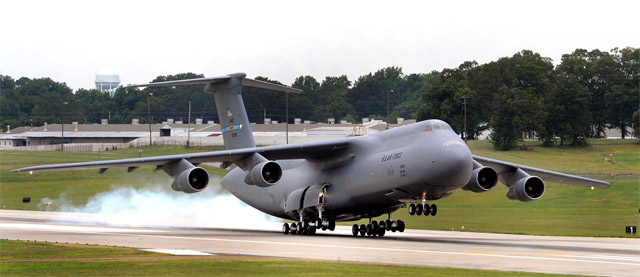
The Class C-1.S Jet category is for aircraft weighing from 250,000 kilograms (551,155 pounds) to 300,000 kg (661,386 lb). The C-5M had a takeoff weight of 649,680 lb, which included fuel, crew weight, necessary equipment, and the payload, which was loaded on 29 standard U.S. military 463L cargo pallets. All C-5s are capable of carrying 36 pallets.
The flight set a new record for altitude with payload of 41,188 feet. It also set marks for time-to-climb and time-to-climb with 35,000 kg (77,162 lb), 40,000 kg (88,185 lb), 45,000 kg (99,208 lb), 50,000 kg (110,231 lb), 60,000 kg (132,277 lb), 70,000 kg (154,323 lb), and 80,000 kg payload. The flight took 4 minutes, 13 seconds to reach 3,000 m (9,843 ft) altitude; 7 min., 27 sec to get to 6,000 m (19,685 ft); 13 min., 8 sec. to fly to 9,000 m (29,528 ft); and 23 min., 59 sec to fly to 12,000 meters (39,371 ft).
The flight also broke existing class records for altitude in horizontal flight (41,116 ft) and altitude with 35,000 kg, 40,000 kg, 45,000 kg, 50,000 kg, 60,000 kg, and 70,000 kg payload (41,188 ft). The mission broke the record for greatest payload (80,036 kg/176,610 lbs) to 2,000 meters (6,562 ft) as well.
All of the records will first be certified as United States national records by the National Aeronautic Association, the nation’s oldest aviation organization. The NAA, based in Arlington, Va., is the U.S. representative to the Fédération Aéronautique Internationale (FAI), the sanctioning body for all world aviation records. Formal approval of the C-5M records by the Lausanne, Switzerland-based FAI is expected to take several weeks.
Source: Lockheed Martin
Photo: Lockheed Martin
Today a Fokker 100 (D-AFKE) with 73 passengers and 5 crew on board, made an emergency landing at Stuttgart (Germany).
The Contact Air (Lufthansa Regional) flight 288 from Berlin Tegel to Stuttgart reported landing gear problems during approach.
After several unsuccessfull attempts to unlock the gear, the pilot decided to carry out the emergency landing. The aircraft landed on a foam carpet. The Fokker 100 had just been acquired by Contact Air, entering service on 1 September 2009.
Nobody was seriously injured.
Raw video by AP
This weekend, another Red Bull Air Race is taking place in Porto (Portugal). The Portuguese city on the Douro River will be hosting the race for the third year. Last year a total of one million spectators watched the world’s best pilots in action during the two days, making it one of the biggest crowds ever at a sporting event in Portugal.
This year Qualifying takes place on Saturday 12 September at 14:30 local time followed by Race Day on Sunday 13 September starting at 14:00.
The Red Bull Air Race in Porto, Portugal, on 13th September will be streamed live on
www.redbullairrace.com
Schedule: 9:50AM EST / 13:50 GMT, 13th September, 2009.
Portugal 2009 Preview Video
A British Handley Page Victor Cold War Bomber, that was retired in 1993 accidentally took off during a photo shooting at Bruntingthorpe Airfield (England). The Victor was only meant to have slowly taxied down the runway and stop for a photoshoot, but the co-pilot had accidentally slammed on the throttle, sending it 150ft up into the sky.
Videos
The 70 year old retired RAF pilot, who last flew a Victor in the 1980s, wrestled with the plane’s controls to steer it away from potential disaster.
He landed on one wheel and in a cloud of dust, but without a scratch – on grass at the end of the runway.
Hailed a hero after an inquiry into the near disaster he said it was “the most terrifying nine seconds of my life”. “I was petrified. There wasn’t time to think about anything. Everything was pure instinct on that day. It all happened extremely fast. I was shouting at the co-pilot to pull the throttle back. For some reason he never did and I saw the nose rise into the air, I thought ‘Oh God here we go, how are we going to get out of this one?”
“So I had to make a snap decision: “Do I try to land the plane or do I fly round in a circle and land properly?”
“I put the nose down and noticed that we were well and truly airborne but because of the crosswind we were not over the runway.”
“I thought, ‘where are we and what can we do to rescue the situation?”
“Thankfully, I managed to pitch the plane back towards the runway and away from any spectators.”
“My only concern was getting the plane down as quickly and safely as possible.”
“Although I touched down on the grass I still managed to keep it under control. All that was left to do was get out and kiss the ground.”
“Nobody could really believe what had happened. There were people slapping me on the back and congratulating me on not crashing the thing and ruining the day.”
Read the full story at (many photos included):
http://www.dailymail.co.uk/news/article-1211925/Hero-pilot-averted-air-disaster-pilot-hit-throttle-giant-bomb…
Last week Embraer delivered the first Embraer 170 to British Airways. The aircraft, configured with 76 seats in a singleclass layout, will be operated by BA CityFlyer, British Airways’ wholly owned regional subsidiary, which operates international and domestic routes from London City Airport. The deal was announced in December 2008, and includes firm orders for six EMBRAER 170 and five EMBRAER 190 jets, plus options for another three airplanes of the same model.
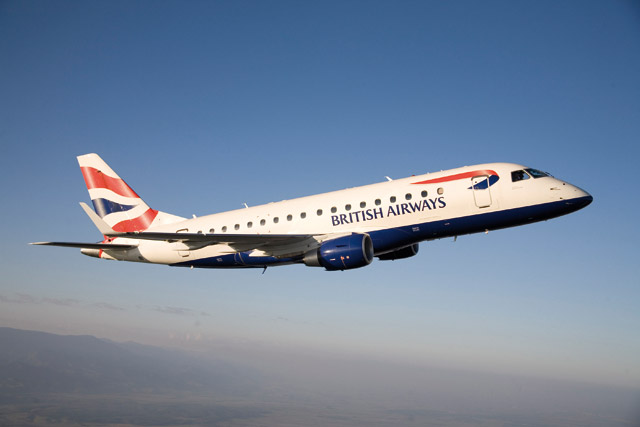
The EMBRAER 170 obtained steep approach certification to operate at London City Airport in June 2007. The steep approach uses a software solution developed within the existing fly-by-wire system, which means improved flight quality and control, as well as
reduced pilot workload, less weight, and lower maintenance costs.
On June 30, 2009, Embraer had logged 882 firm orders and 794 options for the E-Jets family. With nearly 600 aircraft delivered to date, the family has a broad base of 53 operators in 35 countries, on five continents.
The EMBRAER 170/190 family of E-Jets consists of four commercial jets – the EMBRAER 170, EMBRAER 175, EMBRAER 190 and EMBRAER 195 – with 70 to 122 seats. The E-Jets have a maximum cruising speed of Mach 0.82, can fly at 41,000 feet (12,500 meters), and have ranges of up to 2,400 nautical miles (4,448 km).
Photo: Embraer
Source: Embraer
This week, Airbus has delivered the first of two A318 aircraft equipped with “steep approach” capability to British Airways. The A318 is the largest commercial aircraft certified to land at steeper than usual gradients and has the potential to transform long haul travel between city centres, saving time and cost to the business traveller. The delivery makes the carrier a new operator of all four members of the A320 Family.
The “Steep Approach” A318 is certified for a 5.5° approach slope. This compares to a nominal 3° slope for standard operations. During “Steep Approach” certification the aircraft has to demonstrate it can safely achieve a 7.5° angle, equivalent to the targeted angle plus a 2° safety margin. The A318 and A318 Elite, were approved for steep approach landing capability by the European Aviation Safety Agency (EASA) in 2007. The A318 Elite has steep approach capability as standard specification.
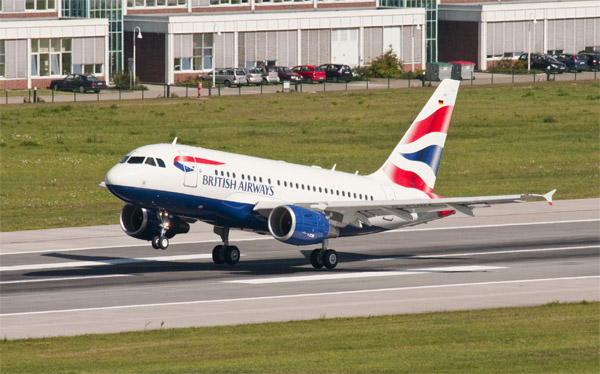
The A318’s ‘steep approach’ capability makes it ideal for operations out of mountainous or otherwise constrained locations such as urban area airports where the aircraft also satisfies strict low noise regulations. British Airways A318s will each be equipped with two CFM 56-5B9/3 engines.
Willie Walsh, British Airways’ chief executive said: “The A318s were specially ordered for the twice-daily London City – JFK service because of their size, flexibility and ‘steep approach’ capability and will reinforce our unrivalled schedule between two of the world’s greatest financial centres. The A318 may be our smallest aircraft but it has a big role to play in bringing a new dimension of style and convenience to the London – New York route and shows our determination to invest in the future.”
“The A318 has the best capability and range of any commercial aircraft serving city centre airports. It enables operators to open new premium routes with enhanced cabin comfort standards thanks to the widest fuselage of any single-aisle aircraft,” said John Leahy, Airbus Chief Operating Officer, Customers.
In British Airways’ layout, the A318s’ Club World cabin will feature a spacious layout with 32 seats that convert into full lie-flat beds, equipped with OnAir connectivity, allowing passengers to work during the flight with email, web surfing and mobile phone text messaging. The two A318s ordered will join a fleet of 11 A321s, 37 A320s and 33 A319s already in service. British Airways has a further nine A320s and 12 A380s on firm order from Airbus.
Photo: Airbus
Source: Airbus
Boeing continues to make progress on the assembly of the 747-8 Freighter, as mechanics completed the installation of the new GEnx-2B engines on airplane No. 1 in final assembly at the factory in Everett, Wash.
The GEnx-2B continues its progress through its engine certification testing. It recently completed the first phase of flight testing on GE’s 747 flying testbed.
The GEnx-2B is based on the GEnx-1B engine launched with the 787 Dreamliner. The GEnx-2B engine has been designed for the 747-8 and rated at 66,500 pounds of thrust.
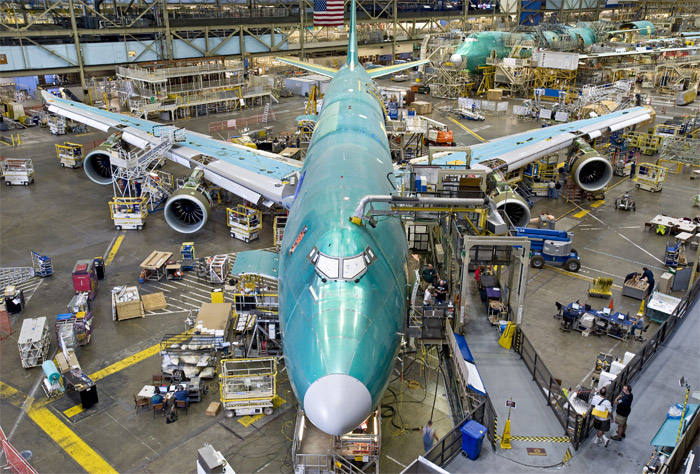
With the GEnx-2B engines, the 747-8 Freighter will be 17 percent more fuel efficient than the 747-400 Freighter, resulting in a 17-percent reduction in carbon emissions. It also will have a noise footprint that is 30 percent smaller than its predecessor, making it a QC2-compliant airplane on both departure and arrival.
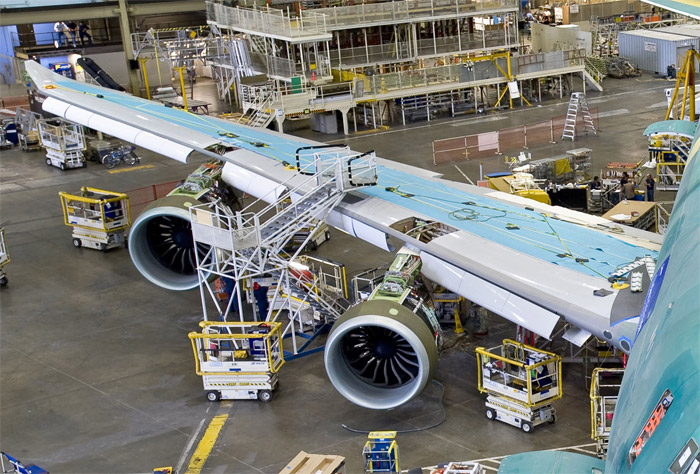
The 747-8 Freighter is expected to make its first flight in the fourth quarter of this year, with first delivery scheduled for the third quarter of 2010. Boeing has secured 78 orders for the new 747-8 Freighter. Cargolux, Nippon Cargo Airlines, AirBridgeCargo Airlines, Atlas Air, Cathay Pacific, Dubai Aerospace Enterprise, Emirates SkyCargo, Guggenheim and Korean Air all have placed firm orders for the airplane.
Thx to Boeing for providing the photo.
Source: Boeing
Photo: Boeing
On Sunday, a Suchoi Su-27 operated by Belarussian Air Force crashed during Radom Air Show in Poland. It’s believed that the crash was caused by a bird strike. Both pilots did not eject and were killed.
Just a few weeks ago 2 Suchoi Su-27 collided near Moscow during a training flight for Maks 2009 Air Show, killing 1 pilot and 1 person on the ground.
On Friday, Airbus has delivered its 4000th A320 Family aircraft to Brazilian flag carrier TAM from its Final Assembly Line in Hamburg.
The aircraft, an A319, is powered with IAE engines and configured in a single-class layout seating 144 passengers. On the A319’s ferry flight from Hamburg to Brazil, TAM transported goods for schools for handicapped children in the region. The equipment was donated by Aviation without Borders Germany (LOG) and facilitated by the Airbus Foundation.


In July more than 10,000 Airbus employees involved in the programme at all Airbus’ sites celebrated the production of the 4000th A320 Family aircraft.
TAM became an Airbus A319 operator in 1998 with a historic combined order of 90 aircraft together with the airlines TACA and LAN. Today the airline operates a fleet of 125 Airbus aircraft. More than 350 Airbus aircraft are in operation in Latin America with 22 carriers. This represents more than 40 per cent of aircraft over 100 seats in service in Latin America.
The A320 Family includes the A318, A319, A320 and A321.
Source: Airbus
Photos: Airbus