F-35B Completes First Aerial Refueling

A STOVL (short takeoff/vertical landing) variant of the Lockheed Martin F-35 Lightning II stealth fighter has become the first F-35 to complete an aerial refueling test using the Navy- and Marine Corps-style probe-and-drogue refueling system. This mission is the first in a short series of tests that will clear the STOVL F-35B variant for extended-range flights, particularly to its primary test site at Naval Air Station Patuxent River, Md.
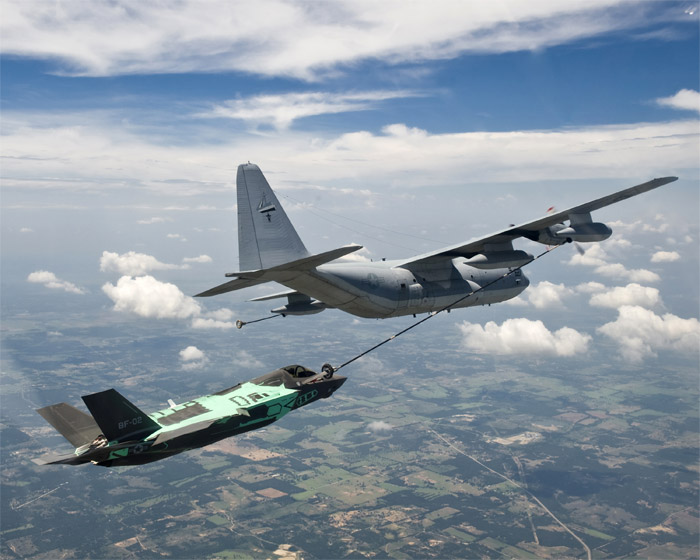
Lockheed Martin F-35B STOVL aerial refueling using KC-130J Tanker

During Thursday’s flight, the F-35B designated BF-2 (the second STOVL flight test aircraft), began a series of tests in which fuel is uploaded into the aircraft at 10,000, 15,000 and 20,000 feet, at speeds ranging from 200 to 250 knots. The pilot on the initial F-35B aerial refueling flight was U.S. Marine Corps Maj. Joseph T. “O.D.” Bachmann.

The refueling mission also marked the first time a Lockheed Martin KC-130J tanker has been used to refuel an F-35. Since deployment to Iraq in 2005 the KC-130J has offloaded more than 186 million pounds of fuel during combat operations. Previous refueling missions with the F-35A conventional takeoff and landing variant were accomplished with a KC-135 tanker. To date, the first F-35A has received approximately 110,000 pounds of fuel during aerial refuelings.

Probe-and-drogue refueling employs a flexible hose that trails from the tanker aircraft. The basketlike drogue at the end of the hose connects to the receiving aircraft’s probe, which, in the case of the F-35, resides on the right side of the forward fuselage and retracts when not in use. The U.S. Navy, Marine Corps and the air forces of many other countries use the probe/drogue system, while the U.S. Air Force refuels its aircraft via a rigid flying boom that inserts into a receptacle on the receiving airplane.

The Lockheed Martin F-35 and F-22 are the world’s only 5th generation fighters, uniquely characterized by a combination of advanced stealth with supersonic speed and high agility, sensor fusion, network-enabled capabilities and advanced sustainment. The three F-35 variants are derived from a common design, are being developed together and will use the same sustainment infrastructure worldwide, bringing economies of commonality and scale.

Lockheed Martin is developing the F-35 with its principal industrial partners, Northrop Grumman and BAE Systems. Two separate, interchangeable F-35 engines are under development: the Pratt & Whitney F135 and the GE Rolls-Royce Fighter Engine Team F136.

Source: Lockheed Martin
Photo: Lockheed Martin
Qatar Receives First C-17 Globemaster III

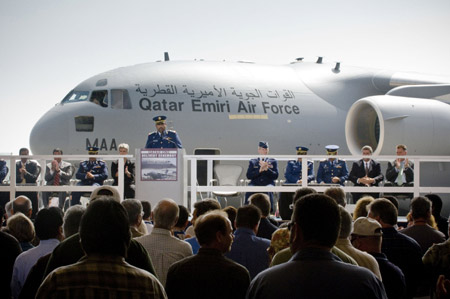
Boeing today delivered Qatar’s first C-17 Globemaster III airlifter to the Qatar Emiri Air Force.

Qatar became the first Middle East nation to order the C-17 when it signed an agreement with Boeing on July 21, 2008, for the purchase of two advanced airlifters and associated equipment and services.

Qatar C-17 Globemaster III
Boeing will deliver Qatar’s second C-17 later this year. The company will provide operational support, including material management and depot maintenance support, under the C-17 Globemaster III Sustainment Partnership.

There are currently 205 C-17s in service worldwide. With today’s delivery, 16 have been placed with international customers. The U.S. Air Force, including active Guard and Reserve units, has 189. International customers include Qatar, the United Kingdom’s Royal Air Force, the Canadian Forces, the Royal Australian Air Force and the 12-member Strategic Airlift Capability consortium of NATO and Partnership for Peace nations. The United Arab Emirates announced on Feb. 24 that it also will acquire four C-17s.

Source: Boeing

Afriqiyah Airways Receives First Airbus A330

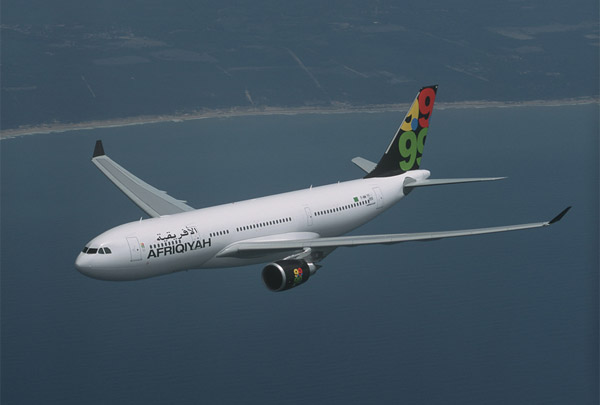
Afriqiyah Airways, based in Tripoli (Libya), has taken delivery of their first Airbus A330-200 aircraft, becoming a new operator of this aircraft type. The new A330 will seat 230 passengers in a two-class cabin and will serve long-haul operations on routes from Tripoli to Africa and Europe.

Afriqiyah Airways Airbus A330-200

The new A330-200, the first of three ordered in 2006, will join Afriqiyah’s existing all Airbus fleet of two A319s and five A320s. This brings the unique benefits of Airbus aircraft commonality to Afriqiyah, who can use the same pool of pilots, cabin crew and maintenance engineers across its entire Airbus fleet.

The airline will take delivery of a further 10 A320 family aircraft in the coming years, and has also selected the A350 XWB, with six A350-800s ordered in 2007.

Source: Airbus
Photo: Airbus

Helicopter and Plane Collision over Hudson River

A tourist tour helicopter, a Eurocopter AS 350 BA (N401LH), operated by Liberty Helicopter Sightseeing Tours and a Piper PA-32R Lance (N71MC) today collided and crashed into the Hudson River (New York). The Piper was heading from Teterboro Airport to Ocean City, NJ, with 3 people aboard. It’s believed that the helicopter had 6 people aboard. Nobody survived.

According to CNN the plane “had a wing sheared off and began “corkscrewing” into the water. The helicopter “dropped like a rock” after the collision”.

Photo of the Helicopter

More at CNN: http://edition.cnn.com/2009/US/08/08/hudson.helicopter.crash/index.html

Photo – An-225 Mriya with New Livery

The world’s largest cargo plane, the Antonov An-225 Mriya (UR-82060) was spotted at Kiev – Gostomel (UKKM) (Ukraine) wearing a fantastic new livery!

Photos from Airliners.net and JetPhotos.net

The new design consists of blue and yellow stripes which represents the flag of the Ukraine. An “Antonov Airlines” logo is painted on the vertical stabilizers.

NTSB Investigation Videos on YouTube

YouTube user “airboyd” recently posted some very interesting NTSB Investigation videos on YouTube.
The NTSB aviation safety videos contain animations about dangerous runway incursion and accidents during landing, like FedEx 647 that caught fire after gear collapse on December 2003 or the Colgan 3407 crash.

All of these videos are grouped into a video playlist. You may watch this in the player below. You can scroll through the playlist using the left and right arrows.

Egyptair Expands 737 Fleet

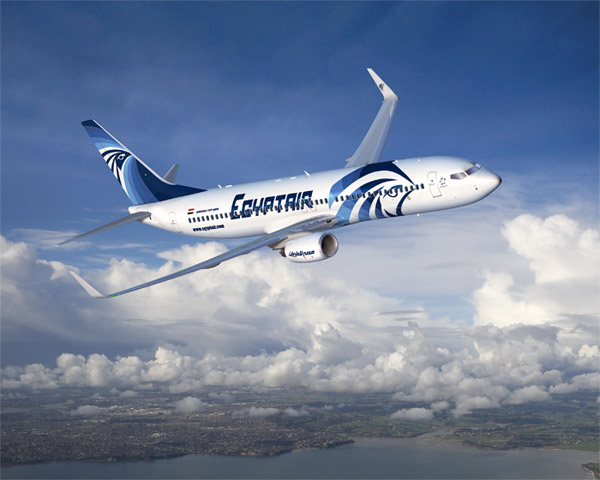
Boeing and EgyptAir today announced that the airline has converted a previous order for two 777s into an order for additional eight Next-Generation 737-800s. The airline currently has seven 737-800s in operation and it is taking delivery of additional five 737-800s this year. The airline currently has five 777s in its fleet and is scheduled to receive six 777-300ERs beginning next year.

Egyptair Boeing 737-800

EgyptAir joined the Star Alliance in July 2008. The carrier has been focused on increasing the utilization of Cairo International Airport as a key regional hub for both passenger and air freight operations.

Image: Boeing
Source: Boeing