First E190 Delivered to LAM

Embraer recently delivered the first EMBRAER 190 jet to Mozambique flag carrier LAM – Linhas Aéreas de Moçambique.
The deal was announced in October 2008 and includes firm orders for two EMBRAER 190s, plus two purchase rights.

LAM’s EMBRAER 190 is configured in a dual-class layout, featuring nine seats in business class and 84 in economy. The aircraft will be based in the capital of Mozambique, Maputo, and will replace older narrowbody jets operated for domestic routes, mainly in the cities of Nampula and Pemba. It will also be used for regional flights to Luanda (Angola), Dar Es Salaam (Tanzania), Nairobi (Kenya), Johannesburg, and in the near future, Cape Town (South Africa), and Addis Ababa (Ethiopia).
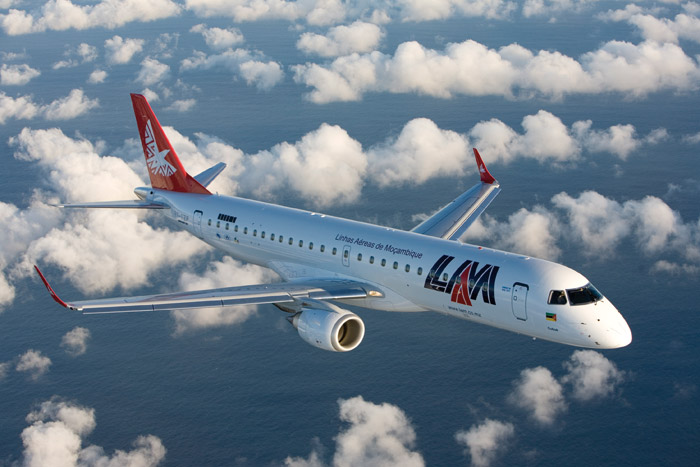
LAM – Linhas Aéreas de Moçambique EMBRAER 190
LAM also signed an Embraer Pool Flight Hour Program service contract to easily and effectively support its EMBRAER 190 jet fleet. The pool program quickly provides replacement aircraft parts and eliminates the need for inventory investments, once Embraer assumes the responsibility for maintaining an inventory at its distribution and service centers, in order to provide parts to operators as soon as they are requested.

Source: Embraer
Photo: Embraer
First C-5M Super Galaxy Delivered

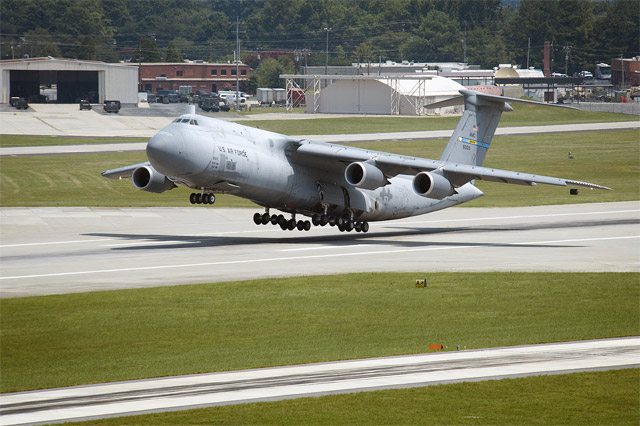
Lockheed Martin today delivered the first fully modernized C-5M Super Galaxy to the U.S. Air Force.

The aircraft is the first of three developmental test C-5M aircraft to be delivered, with the other two to be delivered to Dover AFB, Del., in February 2009. Current Air Force plans call for Lockheed Martin to deliver 52 modernized C-5Ms.

“The C-5 fleet is now beginning to realize its full operational potential as we begin fielding both Avionics Modernization Program and Reliability Enhancement and Re-engining Program enhanced C-5s for the Air Force,” said Lorraine Martin, vice president of the C-5 Program at Lockheed Martin. “The combined U.S. Air Force and Lockheed Martin team can take great pride in its success, which is keeping this national strategic airlift asset viable for decades to come.”

Lockheed Martin C-5M Super Galaxy

The C-5M Super Galaxy is the product of a two-phase modernization effort. The Avionics Modernization Program (AMP) provides a state-of-the-art glass cockpit and a digital backbone to support the Reliability Enhancement and Re-engining Program (RERP) modifications. 46 C-5 aircraft have completed the AMP modifications. The aircraft already returned to the fleet have logged more than 45,000 hours with the new systems, including many hours flown in support of Operation Iraqi Freedom.

RERP is the second phase of the modernization effort, which adds new GE CF6-80C2 commercial engines (military designation F138-GE-100) and 70 other enhancements or replacements of major components and subsystems. The additional 10,000 lbs of thrust per propulsion system creates 40,000 lbs of additional thrust across the platform, significantly improving operational performance. This comprehensive modernization program improves the fleet mission-capable rate (aircraft availability) and the overall reliability and maintainability of the aircraft while reducing total ownership costs.

The C-5 has been the backbone of strategic airlift in every engagement since it entered service. It is the only aircraft capable of carrying 100 percent of certified air-transportable cargo, with a dedicated passenger compartment enabling commanders to have troops and their equipment arrive in an area of operation simultaneously. The C-5 can carry twice the cargo of other strategic airlift systems. With more than 70 percent of its structural service life remaining, Lockheed Martin is committed to sustaining the C-5 fleet throughout its lifecycle. The C-5M Super Galaxy will continue to be a force enabler through 2040.

Source: Lockheed Martin
Photo: Lockheed Martin

FAA Changes Standards for Ice Protection Systems

The U.S. Department of Transportation’s Federal Aviation Administration (FAA) today changed its certification standards for transport category airplanes to require either the automatic activation of ice protection systems or a method to tell pilots when they should be activated.

The new rule requires an effective way to ensure the ice protection system is activated at the proper time. The rule applies to new transport aircraft designs and significant changes to current designs that affect the safety of flight in icing conditions. There is no requirement to modify existing airplane designs, but the FAA is considering a similar rulemaking that would cover those designs.

“We’re adding another level of safety to prevent situations where pilots are either completely unaware of ice accumulation or don’t think it’s significant enough to warrant turning on their ice protection equipment,” said FAA Administrator Randy Babbitt.

Under the revised certification standards, new transport aircraft designs must have one of three methods to detect icing and to activate the airframe ice protection system:

  • An ice detection system that automatically activates or alerts pilots to turn on the ice protection system;
  • A definition of visual signs of ice buildup on a specified surface (e.g., wings) combined with an advisory system that alerts the pilots to activate the ice protection system; or
  • Identification of temperature and moisture conditions conducive to airframe icing that would tip off pilots to activate the ice protection system.

The standards further require that after initial activation, the ice protection system must operate continuously, automatically turn on and off, or alert the pilots when the system should be cycled.

The FAA has previously addressed activation of pneumatic deicing boots on many aircraft models by requiring activation of boots at the first sign of ice accumulation. This new certification standard further increases safety by not relying on the pilot alone to observe whether the airplane is accumulating ice. Also this certification standard applies to all types of ice protection systems, not just pneumatic deicing boots.

The full text of the final rule is available at: http://edocket.access.gpo.gov/2009/E9-18483.htm

Related:
Video – Icing on Horizontal Stabilzers

Source: FAA

Safety Report – 08/03/2009


Date: 08/02/2009 23:58
Location: Washington, DC
Aircraft Type: Boeing 757-232 Registration: N652DL
Operator: Delta Air Lines Flight: 1234
Phase: Take-off
Level of Damage: Unknown
Injuries & Fatalities: None
Description: Flight aborted takeoff due to contained left engine fire – fire extinugished – Reagan National Airport Washington DC

Date: 08/03/2009 08:30
Location: Miami, FL
Aircraft Type: Boeing 767 Registration: Unknown
Operator: Continental Airlines Flight: COA128
Phase: Unknown
Level of Damage: Unknown
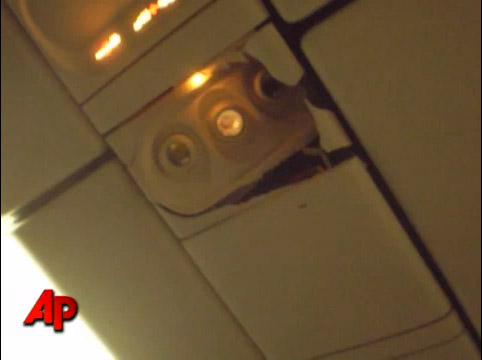
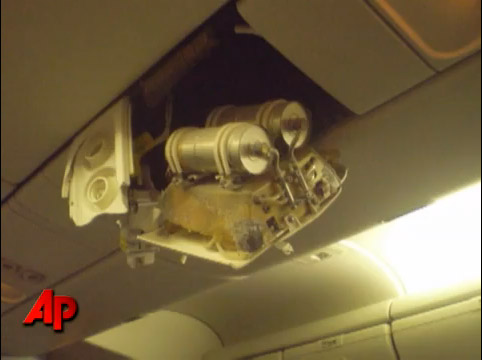
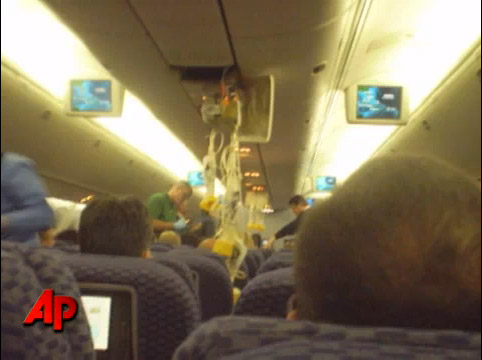
Injuries & Fatalities: 4 passengers seriously injured / 22 passengers minor injured
Description: While enroute, declared an emergency and diverted to Miami after encountering severe turbulence
Video:

Pictures:
Continental Airlines Flight 128 Damage

Source: FAA
Correctness of this posting is not guaranteed & completeness not intended. This posting is just for informational purpose.

Emirates Becomes World’s Largest 777 Operator

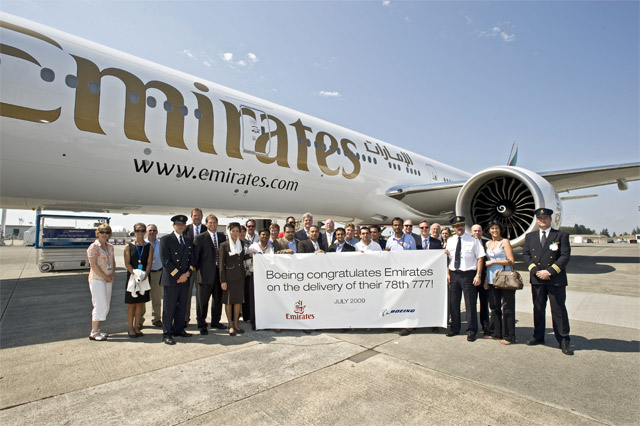
On Wednesday Boeing delivered Emirates’ 78th 777, the airline’s 45th 777-300ER (Extended Range). The Dubai-based carrier is now the world’s largest operator of the 777 and the only airline to operate every model type, with an additional nine 777-200s, 12 777-300s, 10 777-200LRs (Longer Range) and two 777 Freighters in its fleet.

Emirates also has an additional 28 Boeing 777s on order.

Emirates Boeing 777-300ER

Emirates received its first Boeing 777 in 1996. The airline recently completed an upgrade program on all its 777s that equipped the airplanes with Emirates’ award-winning ICE (Information, Communication, Entertainment) system, offering passengers in every cabin up to 1,000 channels of on-demand entertainment.

Source: Boeing
Photo: Boeing

First US NAVY P-8A Poseidon Rolls Out

Boeing and the U.S. Navy on Thursday formally unveiled the newest maritime patrol and reconnaissance aircraft, the P-8A Poseidon.

A derivative of the Next-Generation 737-800, the P-8A is a long-range anti-submarine warfare, anti-surface warfare, intelligence, surveillance and reconnaissance aircraft capable of broad-area, maritime and littoral operations.

“The P-8A Poseidon will equip the U.S. Navy with the most advanced multi-mission maritime patrol and reconnaissance aircraft in the world,” said Jim Albaugh, president and CEO of Boeing Integrated Defense Systems.

Boeing P-8A Poseidon Rolls Out (737-800)

As the replacement for the Navy’s P-3C Orion aircraft, the P-8A will provide greater payload capacity, significant growth potential, unprecedented flexibility and interoperability, and advanced mission systems, software and communications.

The P-8A is built by a Boeing-led industry team that includes CFM International, Northrop Grumman, Raytheon, Spirit AeroSystems and GE Aviation. The team currently is assembling and testing the first five P-8As as part of the program’s System Development and Demonstration contract, awarded in 2004.

The integrated Navy/Boeing team will begin formal flight testing of the P-8A later this year. The Navy plans to purchase 117 P-8As, and initial operational capability is planned for 2013.

Source: Boeing
Photo: Boeing

Airbus delivers 1000th A330/A340 Family Aircraft

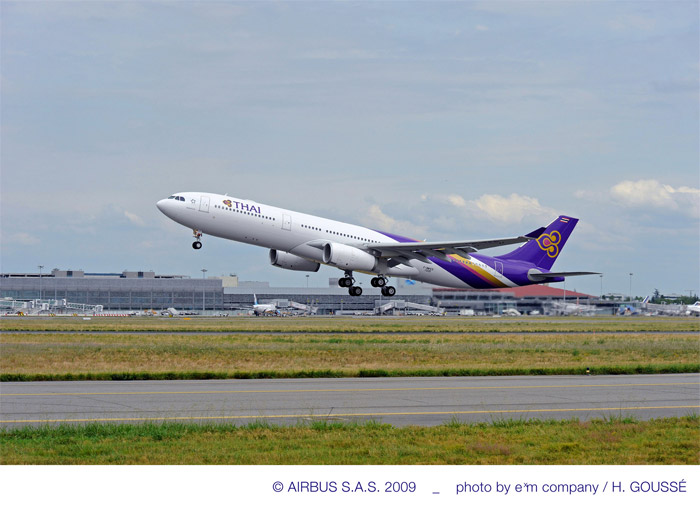
Airbus on Thursday delivered the 1000th aircraft from the A330/A340 Family. The aircraft, an A330-300, was handed over to Thai Airways International (THAI) at a special ceremony in Toulouse.

Speaking at the ceremony, Tom Williams, Airbus Executive Vice President Programmes, said: “When the A330/A340 Family first entered service in 1993 it set a new standard in the mid-size widebody market. Today, the product line remains the benchmark for in-service aircraft in this category, offering airlines a proven range of models optimised for medium, long and very long haul operations.”

Thai Airways International Airbus A330-300

“We are extremely proud that the 1000th aircraft from this product is being delivered in the colours of THAI, which is one of Airbus’ longest standing customers and currently operates a fleet including both the A330 and the A340.”

Air Chief Marshal Narongsak Sangapong, said: “We are pleased to be taking delivery of the 1000th aircraft from this modern and efficient Airbus product line, which forms a major element of our fleet today. With these aircraft we are able to offer our passengers the highest levels of comfort, while also benefiting from the operational flexibility to operate the aircraft both on long range and regional services.”

With today’s delivery, THAI increases its in-service A330/A340 fleet to a total of 25 aircraft, comprising 15 A330-300s, four A340-500s and six A340-600s. The airline also operates a fleet of 17 A300-600Rs on its regional network.

Since the first aircraft from the A330/A340 Family was delivered in 1993, the product line has become the most successful mid-size widebody programme ever, with 1,406 firm orders from 103 customers worldwide. Today, aircraft from the family are flying with 100 operators worldwide and the world fleet has accumulated more than 27 million flight hours in over 5 million revenue flights.

The A330/A340 Family comprises the twin engine A330 for medium and long range operations and the four engine A340 for very long haul routes. A new freighter version of the A330 is currently under development and will enter service in 2010.

Source: Airbus
Photo: Airbus

Video – A380 Arrives at Oshkosh

With a kind of hard crosswind landing, Airbus A380 F-WWDD MSN004 arrived at Oshkosh Air Venture 2009 yesterday. This is the first time that an A380 attends to an North American Air Show.
In addition to flight demonstrations and presentations by Airbus officials and flight crew, self-guided tours of the A380’s interior will be allowed for the first time. Attendees will have the opportunity to walk through the aircraft’s main deck and full-length upper deck.

Video: A380 Hard Landing at Oshkosh (Wittman Regional Airport KOSH) Runway 36

Video Part 1: A380 arriving at Oshkosh Air Venture 2009

Video Part 2: A380 arriving at Oshkosh Air Venture 2009

Ethiopian Airlines Orders several Airbus A350 XWBs

Airbus today announced that Ethiopian Airlines has signed a Memorandum of Understanding (MoU) for 12 Airbus A350 XWB aircraft, becoming a new Airbus customer. The airline has selected the A350-900, and will operate the aircraft from their hub in Addis Ababa, linking Africa with Europe, the US and Asia.

“The A350-900, with its high levels of passenger comfort combined with unbeatable economics perfectly fits our future fleet requirements,” said Mr Girma Wake, CEO of Ethiopian Airlines. “The A350-900 will bring increased capacity and range to our rapidly expanding network.”

“We are delighted to welcome Ethiopian Airlines as a new Airbus customer,” said John Leahy, Airbus Chief Operating Officer, Customers. “The A350 XWB will shape new levels of efficiency for medium and long haul operations, allowing Ethiopian Airlines to continue its impressive growth.”

The A350 XWB Family is Airbus’ response to widespread market demand for a series of highly efficient medium-capacity long-range wide-body aircraft. With a range of up to 8,300 nm / 15,400 km, it is available in three basic passenger versions.

Firm orders for the A350 XWB now stand at 493 from 31 customers worldwide.

Source: Airbus

Ethiopian Airlines Orders 5 777-200LRs

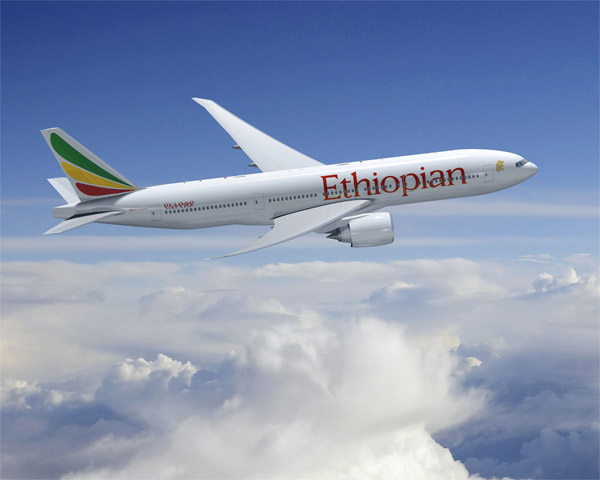
Boeing and Ethiopian Airlines today announced an order for five Boeing 777-200LRs. Ethiopian Airlines becomes the first African carrier to order and operate the ultra-long-range 777-200LR model.

General Electric GE90-110 engines power the 777-200LR.

Ethiopian Airlines Boeing 777-200LR

Based in Addis Ababa, Ethiopia, the carrier is investing in the additional airplanes to expand its fleet and broaden its network. Ethiopian Airlines will use the 777-200LR to fly to new long-haul nonstop markets such as Washington, D.C. and Beijing.

Ethiopian currently operates a fleet of six 737s, nine 757s, 10 767s and one MD-11BCF, with a second MD-11BCF due to arrive in August. It has 10 787s on order.

Image: Boeing
Source: Boeing