Copa Airlines Orders 13 737-800s

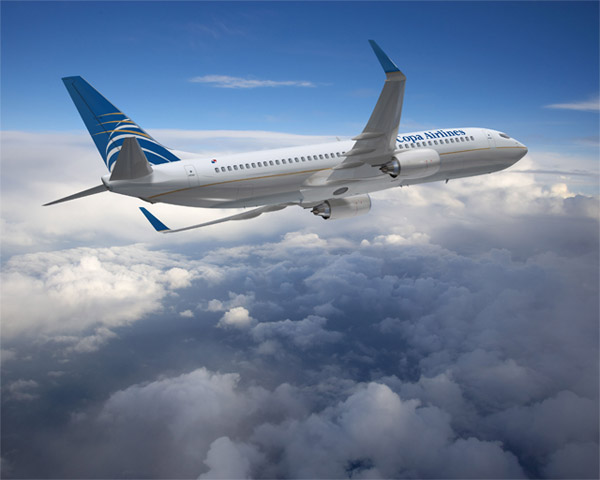
This week Boeing announced that Copa Airlines (Panama) placed an order for 13 Boeing 737-800 airplanes, plus options for an additional eight.

The order represents a mixture of option conversions and new orders and brings the number of Boeing Next-Generation 737s the airline has on order to 27.

The airplanes will be outfitted with Boeing’s signature Sky Interior. Drawing from years of research used to design the interior for the 787 Dreamliner, the 737 Boeing Sky Interior features new, 787-style sculpted sidewalls and window reveals that provide passengers with a greater connection to the flying experience.

Copa Airlines Boeing 737-800

Copa was the first carrier in the Americas to incorporate blended winglets on its 737s. All of its Next-Generation 737s use the distinctive curved wing ends, which improve fuel efficiency and lift while reducing engine wear and carbon dioxide emissions. Copa also was the first in the region to order Next-Generation 737s with the Vertical Situation Display system, which provides pilots with an easy-to-understand flight-path view.

Copa operates from Tocumen International Airport, a time-saving hub on long routes between the United States, South and Central America, and the Caribbean. The airline flies four of the world’s longest 737 routes from there – to Buenos Aires, Santiago, Sao Paulo and Los Angeles.

Source: Boeing
Image: Boeing

Photos – Southwest 2294 Damaged Fuselage Section

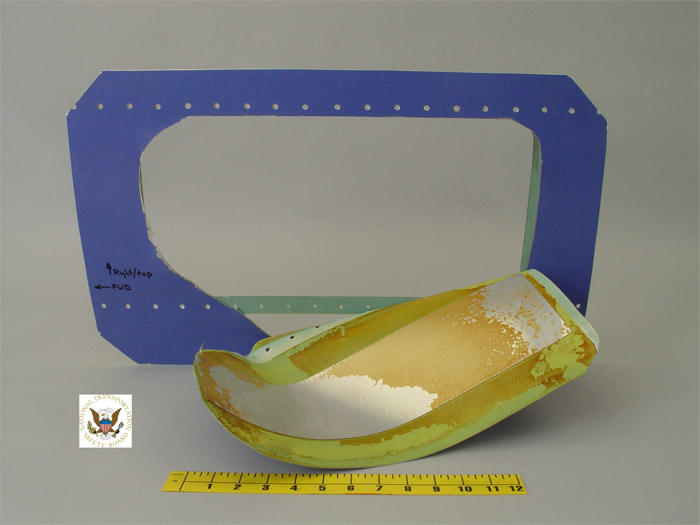
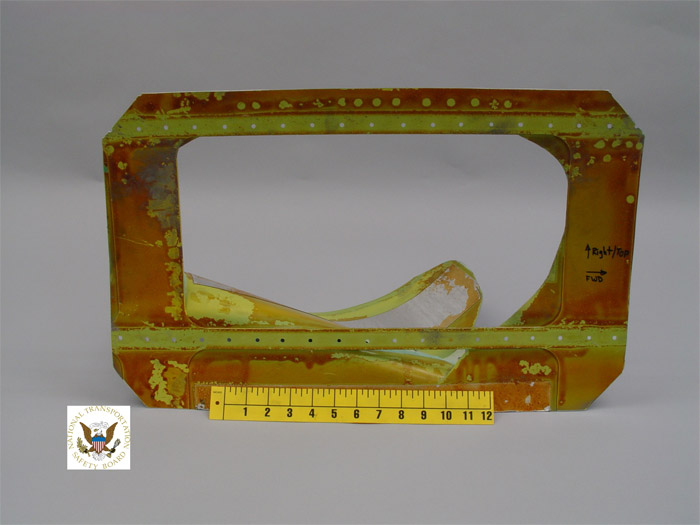
The NTSB released the following two photos of Southwest Airlines 737-300 (N387SW), Flight 2294, that experienced a rapid decompression after a hole opened in the fuselage on July 13, 2009.

Southwest 2294 Damaged Fuselage
Damaged section of fuselage skin facing outside the aircraft
Southwest Airlines 737-300 (N387SW) Flight 2294 Damaged Fuselage

Damaged section of fuselage skin facing inside the aircraft
Southwest Airlines Flight 2294 Hole in Fuselage

The damaged aircraft skin section was visually examined in the NTSB’s Materials Laboratory. The damage left a hole measuring approximately 17 inches by 8 inches. The skin in this area of the fuselage is 0.032 inches thick with an additional 0.032 inch thick layer bonded to the interior surface in selected areas.

According to NTSB the initial visual examination found the fractures in good condition and suitable for further analysis. No significant corrosion or obvious pre-existing mechanical damage was noted. A detailed metallurgical examination of the skin section and the fracture surfaces will be accomplished by the Safety Board in the coming days.

Southwest Airlines is now in the process of repairing the aircraft at Yeager Airport, Charleston, West Virginia.

Photos: NTSB

Related:
* April 2011 – Second Southwest B737 Fuselage Rupture
Southwest Boeing 737 – Hole in Fuselage

Southwest Boeing 737 – Hole in Fuselage

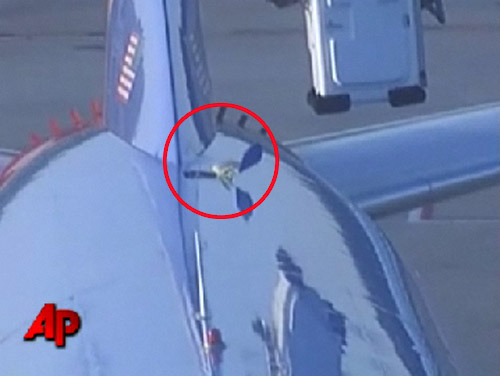
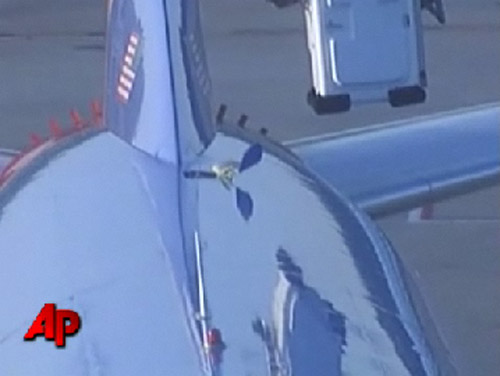
On Monday evening, Southwest Airlines flight 2294, a Boeing 737-300, made an emergency landing at Charleston after a hole opened in the fuselage. The Flight was on its way from Nashville to Baltimore at 34,000 feet when it depressurized and the oxygen masks deployed.

Photo from outside – Looking at upper fuselage

Southwest Airlines Flight 2294 - Hole in Fuselage

Photo from inside – Cabin head covering being sucked out

Southwest Airlines Flight 2294 Hole in Cabin

It’s still not clear what caused the hole, about one foot square, in the upper fuselage near the vertical stabilizer. Southwest Airlines says it’s found no evidence of structural problems in the rest of its 200 Boeing 737-300 aircraft. Passengers said they heard a “loud pop” about 45 minutes into the flight. NTSB is investigating.

Video by AP

Raw Video filmed by passenger

Caspian Airlines Tupolev 154M Crashed in Iran

Today a Caspian Airlines Tupolev 154M (EP-CPG) crashed near Qazvin (Iran), killing all 153 passengers and 16 crew members on board. The flight RV7908 was bound from Tehran-Imam Khomeini International Airport (IKA) (Iran) to Yerevan Airport (EVN) (Armenia) when it crashed 16 minutes after takeoff.

According to local media, the airplane slammed into the ground and exploded on impact, creating a 10 m deep crater.

Video by AP

Raw Video

Fossett Crash – NTSB Report Released

Yesterday, the NTSB has released its report on the crash of Steve Fossett on September 3 2007, near Mammoth Lakes.
The Board determined downdrafts, that exceeded the climb capability of the airplane, as probable cause of the crash. Contributing to the accident were high density altitude, and mountainous terrain.

Examination of the accident site revealed that the Bellanca 8KCAB-180 (N240R) piloted by Steve Fossett was on a northerly heading at impact, indicating that the pilot had executed a 180-degree turn after radar contact was lost. Ground scars and distribution of the heavily fragmented wreckage indicated that the airplane was traveling at a high speed when it impacted in a right wing low, near level pitch attitude. A postimpact fire consumed the fuselage, with the exception of its steel frame. The wings were fragmented into numerous pieces. The ELT was destroyed. Damage signatures on the propeller blades and the engine crankshaft indicated that the engine was operating at impact. Examination of the airframe and engine revealed no evidence of any malfunctions or failures that would have prevented normal operation.

Visual meteorological conditions existed in the accident area at the time of the accident. Mean winds at 10,000 feet were from 220 degrees at 15 to 20 knots; some gusts of 25 to 30 knots may have occurred. Moderate turbulence and downdrafts of at least 400 feet per minute probably occurred at the time and in the area of the accident. The magnitude of the downdrafts likely exceeded the climb capability of the airplane, which, at a density altitude of 13,000 feet, was about 300 feet per minute.

Link: Full NTSB Report

Video – 787 Dreamliner Test on Runway

Boeing 787 test plane ZA001 (N787BA) recently conducted its first taxi tests at Paine Field. This is the first time the Boeing 787 has moved on a runway under its own power. The test pilots were checking the steering and braking system.
The Rolls Royce Trent 1000 just sounds great! Reminds me of the amazing GE90 🙂


Video by daveaboyac

This video shows further testing, but is without sound, unfortunately:

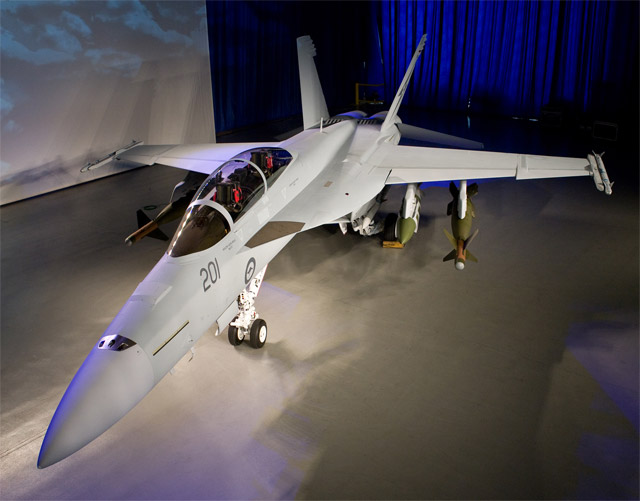
First Australian F/A-18F Super Hornet Unveiled

Boeing today announced the unveiling of the first F/A-18F Block II Super Hornet for the Royal Australian Air Force (RAAF). The aircraft will be delivered later this month.

Back in March 2007, the Australian government placed the order of 24 F/A-18F multirole fighters, making that country the first international Super Hornet customer. The remaining 23 Super Hornets, each equipped with the Raytheon-built APG-79 Active Electronically Scanned Array (AESA) radar, will be delivered to the RAAF throughout 2010 and 2011.

Royal Australian Air Force (RAAF) F/A-18F Block II Super Hornet

The Block II F/A-18E/F Super Hornet is a multirole aircraft, able to perform virtually every mission in the tactical spectrum, including air superiority, day/night strike with precision-guided weapons, fighter escort, close air support, suppression of enemy air defenses, maritime strike, reconnaissance, forward air control and tanker missions. Boeing has delivered more than 395 F/A-18E/Fs to the U.S. Navy.

Source: Boeing
Photo: Boeing

Intermediate Report on Air France Flight 447 Crash

Today, the French Bureau of Enquiry and Analysis for Civil Aviation Safety (BEA) has released a first intermediate investigation report on the Air France flight 447 crash from June 1.

The report reveals that the plane (Airbus A330-200 F-GZCP / MSN: 660) was not destroyed in flight and had likely struck the surface of the water in a straight line, with a high rate vertical acceleration.

The airplane had taken off from Rio de Janeiro without any known technical problems, except on one of the three radio handling panels. No problems were indicated by the crew to Air France or during contacts with the Brazilian controllers. No distress messages were received by the control centres or by other airplanes. The last radio exchange between the crew and Brazilian ATC occurred at 1 h 35 min 15 s. The airplane then arrived at the edge of radar range of the Brazilian control centres. At 2 h 01, the crew tried, without success for the third time, to connect to the Dakar ATC ADS-C system. Up to the last automatic position point, received at 2 h 10 min 35 s, the flight had followed the route indicated in the flight plan.

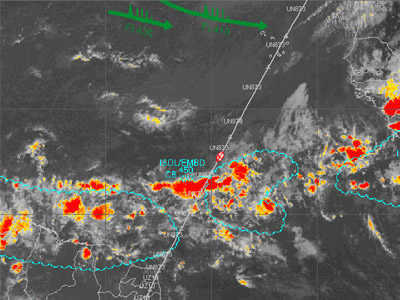
Weather
The meteorological situation was typical of that encountered in the month of June in the inter-tropical convergence zone. There were powerful cumulonimbus clusters on the route of AF447. Some of them could have been the centre of some notable turbulence. Several airplanes that were flying before and after AF 447, at about the same altitude, altered their routes in order to avoid cloud masses.

Air France Flight AF447 Weather Radar Map

ACARS
Twenty-four automatic maintenance messages were received between 2 h 10 and 2 h 15 via the ACARS system. These messages show inconsistency between the measured speeds as well as the associated consequences. Before 2 h 10, no maintenance messages had been received from AF 447, with the exception of two messages relating to the configuration of the toilets.
The last ACARS message was received towards 2 h 14 min 28 s.

ACARS messages:
FLR = Fault
WRN = Cockpit Warning

  • 02:10:10 – .1/WRN/WN0906010210 221002006AUTO FLT AP OFF

    Autopilot disconnection other than by pressing the push-button provided for that purpose on the control sticks

  • 02:10:16 – .1/WRN/WN0906010210 226201006AUTO FLT REAC W/S DET FAULT

    Unavailability of the reaction to wind shear detection function

  • 02:10:23 – .1/WRN/WN0906010210 279100506F/CTL ALTN LAW

    Switching to alternate flight control law

  • 02:10:29 – .1/WRN/WN0906010210 228300206FLAG ON CAPT PFD SPD LIMIT
    02:10:41 – .1/WRN/WN0906010210 228301206FLAG ON F/O PFD SPD LIMIT

    Disappearance of the display of the characteristic speeds (in particular VLS and green dot) on the Captain and First Officer PFDs, with display of the SPD LIM flag at the bottom of the speed scales due to unavailability of the FMGEC’s characteristic speed calculation function.

  • 02:10:47 – .1/WRN/WN0906010210 223002506AUTO FLT A/THR OFF

    Disconnection of the auto-thrust other than by pressing the button provided for that purpose on the throttle control levers (instinctive disconnect) or that the throttle control levers were moved to the idle notch.

  • 02:10:54 – .1/WRN/WN0906010210 344300506NAV TCAS FAULT

    TCAS is inoperative

  • 02:11:00 – .1/WRN/WN0906010210 228300106FLAG ON CAPT PFD FD
    02:11:15 – .1/WRN/WN0906010210 228301106FLAG ON F/O PFD FD

    Disappearance of the Flight Director on the Primary Flight Displays, Captain and First Officer sides, and display of the red FD flag

  • 02:11:21 – .1/WRN/WN0906010210 272302006F/CTL RUD TRV LIM FAULT

    Unavailability of the rudder deflection limitation calculation function. The limitation value remains frozen at the current value at the time of the failure (until the slats extension command is given).

  • 02:11:49 – .1/FLR/FR0906010210 34111506EFCS2 1,EFCS1,AFS,,,,,PROBE-PITOT
    1X2 / 2X3 / 1X3 (9DA),HARD
    02:11:55 – .1/FLR/FR0906010210 27933406EFCS1 X2,EFCS2X,,,,,,FCPC2 (2CE2)
    /WRG:ADIRU1 BUS ADR1-2 TO FCPC2,HARD

    Detection of different speed by pitot probes. Detection of decreasing speed of more than 30 kt in one second of the “polled” speed value.

    Airbus A330 Pitot Probes

  • 02:12:10 – .1/WRN/WN0906010211 341200106FLAG ON CAPT PFD FPV
    02:12:16 – .1/WRN/WN0906010211 341201106FLAG ON F/O PFD FPV

    Disappearance of the Flight Path Vector (bird) on the PFDs (Primary Flight Displays), Captain and First Officer sides, and display of the red FPV (Flight Path Vector) flag

  • 02:12:51 – .1/WRN/WN0906010212 341040006NAV ADR DISAGREE

    The Electronic Flight Control Systems have rejected an Air Data Reference, and then identified an inconsistency between the two remaining Air Data References on one of the monitored parameters.

  • 02:13:08 – .1/FLR/FR0906010211 34220006ISIS 1,,,,,,,ISIS(22FN-10FC) SPEED OR MACH FUNCTION,HARD

    Internal failure at the level of the Calibrated Airspeed or Mach elaboration function. The Calibrated Airspeed or Mach values are outside certain limits.

  • 02:13:14 – .1/FLR/FR0906010211 34123406IR2 1,EFCS1X,IR1,IR3,,,,ADIRU2(1FP2),HARD

    Unexplained fault

  • 02:13:45 – .1/WRN/WN0906010213 279002506F/CTL PRIM 1 FAULT
    02:13:51 – .1/WRN/WN0906010213 279004006F/CTL SEC 1 FAULT

    Flight Control Primary Computer 1 and Flight Control Secondary Computer 1 have stopped functioning.

  • 02:14:20 – .1/FLR/FR0906010213 22833406AFS1,,,,,,,FMGEC1(1CA1),INTERMITTENT

    Unexplained fault detected for less than 2.5 seconds

  • 02:14:26 – .1/WRN/WN0906010214 213100206ADVISORY CABIN VERTICAL SPEED

    A cabin altitude variation greater than 1,800 ft/min for five seconds.

Investigation of the recovered tail fin showed that the frames broke during a forward motion with a slight twisting component towards the left. A recovered galley was not very distorted. Baskets and racks were compressed in the lower part of both galley carts. The distortions observed in the metal vertical reinforcements of a toilet door showed evidence of great compressive forces. Fragments of the walls of the flight crew rest area were crumpled and those of the ceiling were deformed downwards. The floor was curved under the effect of a strong upward pressure from below. The connecting brackets between the floor and the walls were bent
backwards.

The agency also published further in-depth details about the weather at time of the crash, information about pitot probes, location of wreckage, as well as the general condition of the plane prior to the accident.
Also included in this investigation report is the full ATC transcript as well as some new photos of recovered wreckage.

Links
Intermediate Investigation Report (English) – Does NOT include several additional information such as ATC transcript and weather details!:
http://www.bea.aero/docspa/2009/f-cp090601e1.en/pdf/f-cp090601e1.en.pdf

Intermediate Investigation Report (French) – Complete report including ATC transcript and weather!:
http://www.bea.aero/docspa/2009/f-cp090601e1/pdf/f-cp090601e1.pdf

Source & Images: Bureau of Enquiry and Analysis for Civil Aviation Safety (BEA)

Related:
More New Photos of AF447 Wreckage
New Photos Of AF447 Wreckage
Photos – AF447 Wreckage
Photos – AF447 Tail Recovered from Atlantic Ocean

Yemenia Airways A310 Crashed Near Comoros

Today Yemenia Airways flight IY626, an Airbus A310-324 (7O-ADJ, MSN: 535), bound from Sanaa (SAH, Yemen) to Moroni (HAH, Comoro Islands) crashed into the Indian Ocean while on approach. According to unconfirmed reports 141 passengers and 11 crew died, 1 child apparently survived. Weather in the area at the time of the crash was stormy, with high seas.

The plane was delivered from the production line in 1990 and has been operated by Yemenia since October 1999. The aircraft had accumulated approximately 51,900 flight hours in some 17,300 flights. It was powered by Pratt and Whitney engines PW4152.

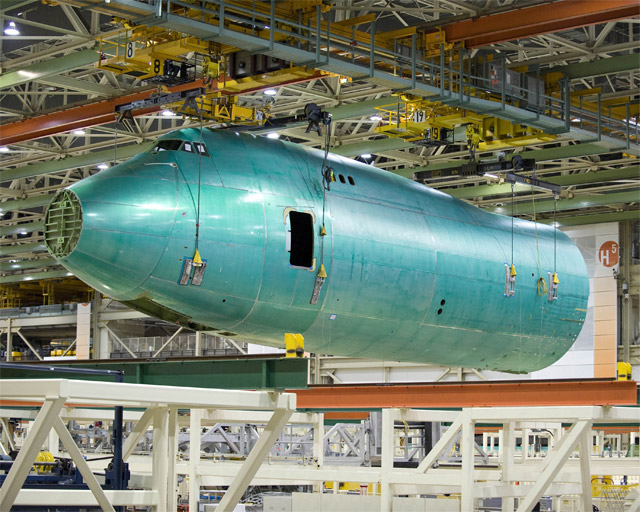
Photos – 747-8 Freighter – Boeing Joins Wings with Body

Boeing today announced that they have completed another milestone in the assembly of the first 747-8 Freighter by joining the wings to the fuselage. The 40-foot (12 m) fuselage section was attached to the center wing box in the final assembly bay at the factory in Everett. The wing and center section are now being prepared for final body join, when the assembly will be connected to the forward and aft fuselage sections.

Boeing 747-8 Freighter Wings and Fuselage Joining
Boeing 747-8 Freighter Fuselage

The 747 Program has secured 78 orders from cargo operators for the new 747-8 Freighter. Cargolux, Nippon Cargo Airlines, AirBridgeCargo Airlines, Atlas Air, Cathay Pacific, Dubai Aerospace Enterprise, Emirates SkyCargo, Guggenheim and Korean Air all have placed orders for the airplane.

Source & Photos: Boeing