Asia’s largest Air Show opened in Hong Kong (Photos)

The world’s biggest passenger jet flew through Hong Kong harbour Monday to mark the arrival of Asia’s largest air show.

The double-decker Airbus A380 roared past the city’s famous skyscrapers to open the four-day Asian Aerospace International Expo and Congress, now a purely civilian show after years of focussing on military and commercial aircraft.

After 25 years in Singapore, Asian Aerospace is being staged in Hong Kong, with delegates from the mainland’s aviation authorities and airlines among some 10,000 visitors expected to check out the latest products on offer.

Photos via Flickr Hong Kong Group – by lukas.jenkner

a380 hong kong

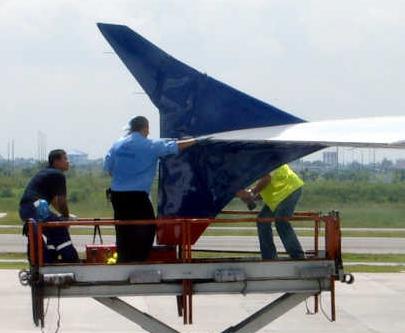
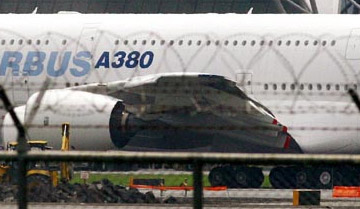
Note the missing wingtip fences (winglets) – removed due to the Bangkok accident!

a380 hong kong

Fatal Plane Crash at Airshow in Poland (Video)

Two Zlin planes collided in mid-air during aeroplane acrobatics taking place at the Radom Air Show in Poland. The two pilots, Lech Marchlewski (the director of the Radom air club, founder and the leader of the “Zelazny” group) and Polish Championship representative, Piotr Banachowicz both died.
There were no reports of injuries among those on the ground – the collision happened well away from the crowd.

Videos


Airbus A380 hits building at Bangkok Airport

A tip of an Airbus A380’s wing scraped a repair building at the Suvarnabhumi airport, Bangkok while preparing for a test flight to Chiang Mai on Saturday morning.

Airbus let Thai Airways International (THAI) uses the world’s largest passenger plane in a trial flight from Bangkok to Chiang Mai.

The plane, which arrived in Thailand on Friday as part of the Asian tour to promote its sales, carried 150 VIP guests, businessmen and reporters on this special flight. It was scheduled to leave the airport at 9.45am.

Its tip hit the building when it was backing out of the parking area to the taxiway, officials said. There were no injuries.

THAI president Apinan Sumanaseni said minor damage occurred to the jet’s winglet, and expected that it would take an hour to fix the damage. The flight would be resumed on Saturday afternoon.

Airbus A380 accident Bangkok

The pushback vehicle operator was not blamed for the damage as Mr Apinan said the accident occurred because the jet is so large that it needs more space on the taxiway.

Airbus officials were sanguine.

“This sort of thing happens every day, in every airport around the world,” said Edouard Ullmo, Airbus’ executive vice president of sales for Asia Pacific.

Airbus decided to remove both winglets, designed to stabilise the aircraft in heavy turbulence, before resuming the flight to Chiang Mai Saturday afternoon.

Airbus A380 accident Bangkok

“We can fly with one winglet or no winglets,” said Ullmo. “This is standard procedure.”

The A380’s wingspan is much wider than the B747-400, at 79.8 metres compared to 64.5 metres.

Sources: BangkokPost.com, spiegel.de

Airbus A350 XWB with software-controlled high-lift flap

a350icon.jpgThe latest high-lift technology for the A350 XWB’s wing promises to reduce complexity and better deliver low-speed performance, while also offering significant fuel savings for airlines.
High-lift systems use devices such as flaps and spoilers to create more lift from a wing, most notably during take-off and landing. While Airbus has generally been a leader when it comes to designing these mechanisms, the A350 XWB’s state-of-the-art system adds more intelligence to the wing, allowing for greater dynamic response and flexibility.

The new system integrates a wing’s flap and spoiler movements using a “software coupling.” Whichever way the flap may be deployed, the computer-controlled spoiler automatically moves into the most efficient position. Early wind tunnel tests on a modified A320 wing have proved the viability of a software-controlled spoiler-flap interlink, demonstrating an advantage in lift without any detriment in drag.

The new high-lift flap, which has been patented by Airbus, is a dropped hinge design and consists of a beam with a rotation point. Designated as the “advanced dropped hinge flap,” it is simpler than a conventional flap and requires less moving parts, resulting in a half tonne weight reduction. It is also easier and less costly to maintain. … [Full Article at airbus.com]

Adam Air 737 black boxes finally recovered

Almost 9 months after the Adam Air Boeing 737-4Q8 (PK-KKW) crashed into the sea near Sulawesi (Indonesia), the flight data recorder (FDR) and cockpit voice recorder (CVR) have been recovered. Both recorders have been retrieved by US company Phoenix International. The FDR was recovered on Monday Aug. 27 at noon and the CVR was recovered on Tuesday Aug. 28 at 10am, found not far from each other at a depth of around 1,800m.

The recorders will now be sent to the National Transportation Safety Board in the United States to determine the cause of the accident. Efforts to recover the so-called “black boxes” have been delayed for months due to disagreements over who should pay. Tatang Kurniadi, chairman of Indonesia’s National Transportation Safety declined to comment when asked who was paying the estimated $3m bill for recovering the recorders.
Indonesia is trying to improve its safety image after three aircraft accidents this year prompted the European Union to blacklist all of country’s airlines.
The US Federal Aviation Administration has also downgraded Indonesia’s safety rating to its lowest category.
The Adam Air Boeing 737 Flight 574 plunged into the ocean off the island of Sulawesi on January 1, killing all 102 people on board. The 17-year-old plane was heading from Surabaya in East Java to Manado in northern Sulawesi when it vanished in bad weather. The plane made no distress call, although the pilot had reported concerns over crosswinds.

Final assembly of first A400M begins

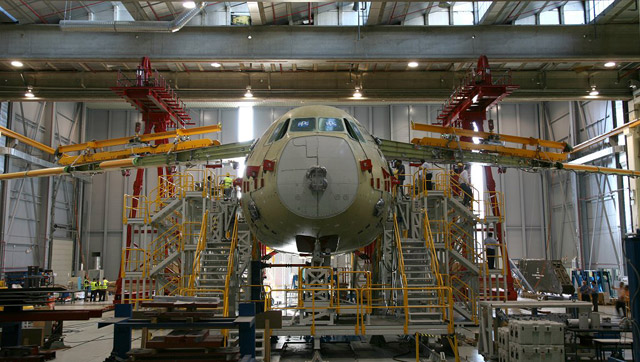
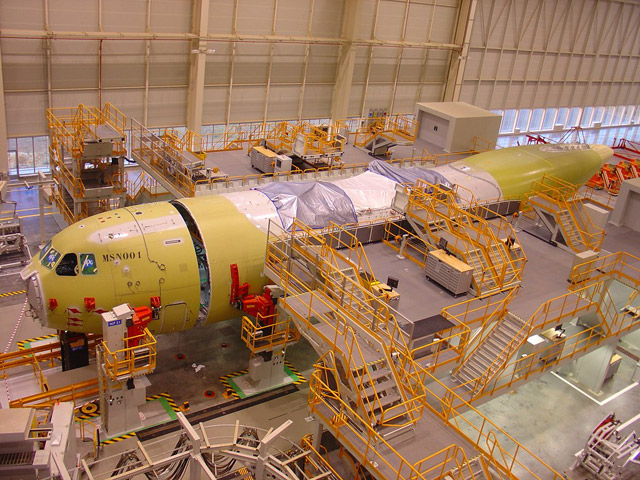
Closely following the assembly in July of the complete static test airframe in the static test facility in Getafe, near Madrid, assembly of the first Airbus Military A400M tactical transport production aircraft, MSN 001, has now begun in Seville.
With the main fuselage barrel and the nose fuselage section already in the jig at the final assembly line (FAL) site at San Pablo, Seville, and the wings and tail surfaces in situ, series production of the new airlifter can now be considered as having formally begun.

The first five aircraft to leave the FAL will be destined for the flight test programme and production at San Pablo will gradually increase to around thirty aircraft per year.

Military A400M tactical transport final assembly

© Airbus Military

TAM Airlines Orders 1000th Boeing 777

Boeing today announced that an order from Brazil’s TAM Airlines for 4 additional 777-300ERs brings to 1003 the number of 777s ordered since the first order of the popular widebody in 1990. Today’s announcement also means that, to date in 2007, Boeing has received orders for 100 of the popular 777s.
TAM is Brazil’s largest airline, flying both domestic and international routes. TAM became the first Latin American airline to incorporate the 777-300ER into its long-range fleet plan when it booked its initial order for four 777-300ERs earlier this year. TAM’s first 777-300ER is scheduled to be delivered in June 2008. Prior to ordering these eight 777s, TAM was an exclusive Airbus operator.
“TAM’s recent orders confirm airline preference for the 777 family which commands more than a 65 percent market share in its category because of its lower operating costs, passenger pleasing cabin and unmatched reliability, ” said Larry Loftis, vice president, Boeing 777 Program. “We have continually enhanced and improved the performance of the 777 family of airplanes. Today, we have grown that family to include two, new, longer range 777s and a freighter version that will enter service in the fourth quarter of 2008.”
Marco Antonio Bologna, TAM’s CEO said the 777-300ER acquisitions are an important step for TAM’s growth in the long-haul international market. “The Boeing 777 provides TAM with unmatched revenue-generating capability, beginning with fuel savings and environmental benefits,” Bologna said. “Further, this is a plane long-haul passengers recognize for its spaciousness, comfort and award-winning interiors.”
The fuel-efficient 777-300ER is the world’s largest long-range twin-engine jetliner capable of carrying 365 passengers up to 7,880 nautical miles (14,594 kilometers). The efficient twin-engine design provides the lowest fuel consumption and overall operating costs in its class.

More than 380 patents for the A380

During the A380 development phase, Airbus filed more than 380 patent applications for technologies developed for the all new double-decker. Since the programme was launched in December 2000, these new technologies have been put through rigorous testing. Significant breakthrough innovations have been achieved in aerodynamics, cabin design, engine integration, flight controls, aircraft systems, manufacturing techniques and the extensive use of advanced lightweight composite materials, making the A380 the world’s most advanced and efficient airliner. These intellectual property rights secure Airbus’ innovations and form a solid basis for maintaining Airbus’ lead in new technological developments.

Among the innovations for which Airbus has filed patent applications is the Zero Splice inlet that is integrated into the A380 engines’ nacelles. This invention, which consists of a single 360 degree composite piece, instead of several separate panels spliced together, contributes significantly to the A380s very low noise emissions.

Another Airbus industry first is the extensive use of advanced lightweight materials, such as Carbon Fibre Reinforced Plastic (CFRP), for the large primary structures of the A380. Airbus has patented a new joining process for producing the world’s first ever carbon-fibre composite centre wing-box for a commercial aircraft. Some 25 per cent of the A380 structure is made of composites, generating a total weight saving of 15 tonnes, which contributes to its low fuel consumption and low noise emissions.

Airbus has also filed patents for the many innovative systems developed for the A380. These include the avionics data communication network (ADCN) which supports the increasing inter-system communication needs with the benefit of further improving data integrity and transmission speed. Another significant breakthrough in aircraft systems is the Brake-to-Vacate function that optimises the amount of energy used for braking and reduces runway occupancy time, while also ensuring a high level of passenger comfort during landing. Patent applications also cover the Electrical Back-up Hydraulic Actuator (EBHA) which is part of the A380’s new two energy, four-channel flight controls architecture. Conventional flight controls architecture on commercial aircraft has three hydraulic channels. The A380 architecture increases the performance and reliability of the flight controls system due to its dual energy source (electrical and hydraulic) and reduces weight by suppressing one hydraulic circuit.

These Airbus patented technologies will continue to be further improved during the service life of the A380 and a number of these have already been adopted for the A350 XWB. Innovation has always been an Airbus hallmark and the A380, about to enter service, definitely sets the standards for the 21st century.