
Boeing today announced that SAS Scandinavian Airlines has exercised options for two Next-Generation 737-800 jetliners. The airplanes will strengthen the 737 fleet of SAS Scandinavian Airlines to support growth on domestic and intra-Europe routes. The airline will equip the airplanes with fuel-saving Blended Winglets. The order was recently posted to Boeing’s Orders & Deliveries Web site attributed to an unidentified customer.
“SAS has ambitious targets to strengthen its position on the Northern European market. With these additional airplanes we can increase frequencies and add routes to our network, thereby serving our customers even better,” said Mats Jansson, president and CEO of SAS Group. “We have a long history of being environmentally conscious, so we’re delighted with the significant emission-reducing improvements of the 737 family.” The SAS Group has a fleet of 88 Boeing 737s.
“The 737 has undergone continuous improvements to meet evolving market demands. As well as being the most high-tech, most reliable single-aisle aircraft available, the Next-Generation 737 has environmentally progressive features such as fuel-saving Blended Winglets and lighter-weight carbon brakes,” said Marlin Dailey, vice president Sales, Europe, Russia & Central Asia, Boeing Commercial Airplanes. The lighter-weight carbon brakes are available on all Next-Generation 737 models from 2008 as a no-charge optional feature.
MD-83 with Emergency Landing at Istanbul (Pictures)
An McDonnell Douglas MD-83 (SU-BOY, 53191/2151) operated by Egyptian carrier AMC Airlines, carrying 163 people, from Hurghada, Egypt (HRG/HEGN) to Warsaw, Poland (WAW/EPWA) caught fire Thursday after making an emergency landing at Istanbul’s international airport (IST), a government official said. One passenger was slightly injured.
The fire in the Egyptian plane was extinguished, and there was no loss of life, said the official at the state agency in charge of airports. He spoke on condition of anonymity because he is not allowed to talk to the media.
The plane was forced to land in Istanbul due to a technical problem, but its main landing gear failed to work properly. The aircraft landed on its fuselage, overran runway 18/36, caught fire and came to rest just short of approach lights.
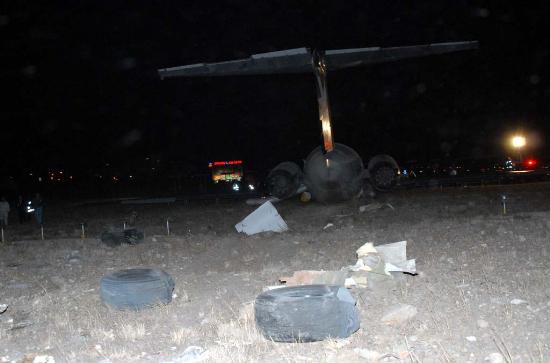
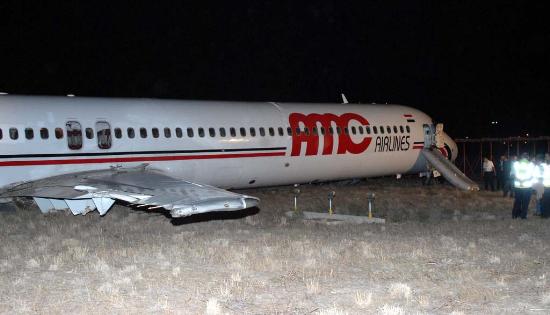
There were 156 passengers and 7 crew members aboard, and one of the passengers was slightly injured.
Link: Gallery with 27 pictures
Sources: AP, flightglobal
Grupo Marsans to order a total of 61 Airbus aircrafts – including A380 and A350 XWB
Grupo Marsans, the largest tourism and transport group in Spain, has signed today a Memorandum of Understanding with Airbus for the purchase of 61 Airbus aircraft including 10 A350-900s, 4 A380s, 5 A330-200s and 42 A320 Family aircraft (of which 12 A319s, 25 A320s and 5 A321s). These aircraft will be operated by Grupo Marsans’ subsidiary airlines Aerolineas Argentinas and Air Comet amongst others in the group. At this stage no engine selection has been made. This new order combines with the previous order for 12 A330-200s and will bring Grupo Marsans’ total commitment with Airbus to 73 aircraft.
Gonzalo Pascual, President of Grupo Marsans, explained: “This purchase is an important step for us at Grupo Marsans in our development. It demonstrates our commitment to enhancing our group’s position on the short and long haul networks by incorporating the most efficient aircraft on the market today. Furthermore with the A380, we will become the first A380 customer and operator in Spain and South America.”
“We are extremely honored by this important vote of confidence from Grupo Marsans. This Memorandum of Understanding is a clear sign that Airbus responds to the market. We are very proud of the selection of the A320 Family, the A350 XWB and the A380 by Grupo Marsans which, as we all know, control Aerolineas Argentinas, Air Comet and several other airlines in Europe and South America,” said John Leahy, Airbus Chief Operating Officer Customers.
Being greener, cleaner, quieter and smarter, the A380 is already setting new standards for transport and the environment. The aircraft is the most fuel efficient aircraft flying today. The combination of extra passenger capacity without increasing the number of flights, excellent environmental performance and lower operating costs is an ideal solution for the airports and the airlines that serve them.
For passengers, the A380 offers wider, more comfortable seats in all classes and the quietest cabins in the sky. Its unique double-deck wide body architecture also gives airlines flexibility to economically offer improved comfort standards without reducing fleet capacity. To current standards for larger premium class products, the A380 can typically carry 525 passengers in three classes in unprecedented comfort on flights of over 8000 nm (15 000 km).
The A350 XWB (Extra Wide-Body) is Airbus’ newest aircraft model and will be the world’s most technically advanced aircraft when it enters service in 2013. Designed to increase productivity and offer unparalleled levels of passenger comfort in its class, the A350 XWB will offer the lowest operating costs and lowest seat mile costs of any aircraft in that category. Addressing environmental concerns and cost-effectiveness, the A350 XWB will be one of the most fuel-efficient aircraft ever.
The A330 is already the aircraft of choice for more than 60 customers and operators around the world and is the unquestioned leader in its class with a commanding market share and a continually expanding operator base. The A330 provides the operator with a significant competitive advantage in the market today through very low operating costs per seat, as well as the widest and most comfortable cabin in its category.
The A320 Family, which also includes the A318, A319 and A321, is recognized as the benchmark in the single-aisle aircraft market and has 5,400 orders and more than 3,200 deliveries to its credit.
Source: Airbus
Boeing delays 787 deliveries and first flight
 Boeing today announced a six-month delay in its planned initial deliveries of the 787 Dreamliner due to continued challenges completing assembly of the first airplanes.
Deliveries of the Dreamliner are now slated to begin in late November or December 2008, versus an original target of May 2008. First flight is now anticipated around the end of first quarter 2008.
The company said the financial impact of the delay would not be material to earnings and that its earnings guidance for 2007 and 2008 remained unchanged.
“We are disappointed over the schedule changes that we are announcing today,” said Boeing Chairman, President and Chief Executive Officer Jim McNerney. “Notwithstanding the challenges that we are experiencing in bringing forward this game-changing product, we remain confident in the design of the 787, and in the fundamental innovation and technologies that underpin it.”
Early last month, Boeing announced a delay in the planned first flight of the 787 citing ongoing challenges with out-of-sequence production work, including parts shortages, and remaining software and systems integration activities. The company also acknowledged increasing risk to the delivery schedule, indicating that the margin to accommodate unexpected issues had been eliminated. The newly revised schedule for first flight and first delivery addresses the production challenges and restores margin for the program to deal with issues that may be uncovered in final ground or flight testing. Boeing also said today that flight control software and systems integration activities are not pacing items in the revised schedule for first flight.
“While we have made some progress over the past several weeks completing work on our early production airplanes and improving parts availability across the production system, the pace of that progress has not been sufficient to support our previous plans for first delivery or first flight,” said Scott Carson, president and CEO of Boeing Commercial Airplanes. “We deeply regret the impact these delays will have on our customers, and we are committed to working with them to minimize any disruption to their plans.
“The most important commitment we’ve made to our customers is to deliver an airplane that performs to their expectations over the long life of the program. These changes to our schedule will help ensure we do just that,” Carson said.
Boeing delivers first 777-300ER to Air India
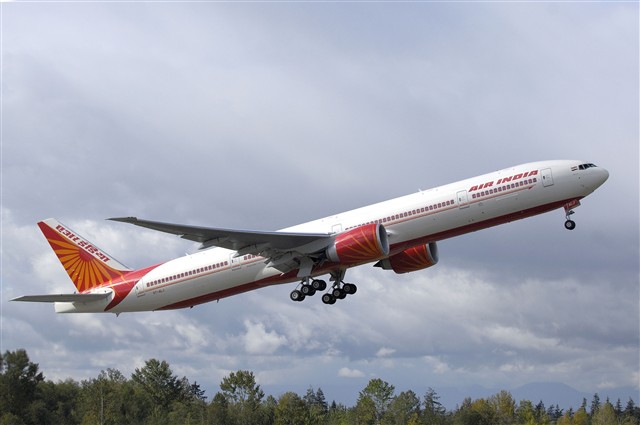 Boeing and Mumbai-based Air India today celebrated the delivery of the airline’s first 777-300ER (Extended Range) airplane. This is the first 777-300ER from Air India’s order of 68 Boeing jetliners placed in December 2005. Air India’s 777-300ER has a three-class configuration, including four first-class, 35 executive class and 303 economy seats. In July 2007, Boeing and Air India celebrated the delivery of the airline’s first 777, a 777-200LR (Longer Range) Worldliner airplane. To date, Air India has received 14 airplanes from its December 2005 order, including three 777-200LRs (Longer Range) and one 777-300ER, and 10 737-800s for Air India Express.
Wizz Air orders additional 50 Airbus A320
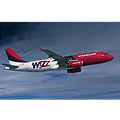 Wizz Air, the Central and Eastern Europe based low cost airline, has signed a firm contract with Airbus for an additional 50 A320s, taking the total orders of the airline up to 82 A320 aircraft.
The contract represents the largest ever order in the region for a single Airbus type, and will enable Wizz Air to become one of the biggest airlines in Central and Eastern Europe within the next decade. Wizz Air have already ordered 32 new A320s from Airbus, and operate several additional A320s on lease.
The aircraft will be configured with 180 seats in a single class layout. The new aircraft will allow Wizz Air to increase frequencies on existing services, as well as to introducing new routes for the region.
“Wizz Air has demonstrated its ability for sustainable growth, where cost efficiency is the key to generate market and win competition. Our choice of aircraft plays a big part in this cost efficiency. The A320 continues to deliver low operating costs, high operational reliability and customer satisfaction whilst enabling us to remain environmentally conscious. The new aircraft order will make Wizz Air the largest fleet operator in the region.” said József Váradi, Chief Executive Officer of Wizz Air.
“We are very proud to take part in the tremendous growth of Wizz Air in the Central and Eastern Europe region,” said Airbus Chief Operating Officer Customers, John Leahy. “The new order strongly underpins Wizz Air’s aspirations to expand. The A320 Family is clearly the leading aircraft in its category, and this milestone order really endorses the superiority of our product,” he added.
Tiger Airways confirms order for 30 more A320
Tiger Airways, Asia Pacific’s fast growing low-fare carrier, has signed a contract for an additional 30 Airbus A320s and 20 options. The Memorandum of Understanding was signed at the Paris Airshow in June 2007.Tiger Airways currently operates a fleet of nine A320s, with 11 more to be delivered by 2010. With the latest order and option package, Tiger Airways’ fleet has the ability to grow to 70 A320s.
The A320s will be deployed on the airline’s Asia Pacific and Australian networks that currently extends to 20 services in seven countries, as well as the new Australian domestic operation scheduled to be launched out of Melbourne on 23rd November 2007 (pending regulatory approval). Tiger Airways’ A320s will be configured in a 180-seat, all-economy configuration. No engine choice has been made.
“Tiger Airways is expected to enjoy impressive growth from our Singapore international and Australian domestic networks, and we are expanding our aircraft fleet to meet continued strong demand for affordable air travel across the Asia Pacific region. The new order will take our total fleet of Airbus A320 aircraft to 70, making Tiger Airways one of the region’s largest A320 operators,” said Tony Davis, Chief Executive Officer of Tiger Airways.
“In just over three years, Tiger Airways has developed into a formidable success story, and we are delighted they did it with our aircraft and are continuing to expand with Airbus jetliners. The A320 is undoubtedly the world’s favourite single-aisle aircraft, offering superb economics and high passenger appeal,” said John Leahy, Airbus Chief Operating Officer Customers.
Total orders for the A320 stand at 3145 aircraft. (Results at end of September 2007.)
Wreck Of Skydiving Plane Found
(AP) Ground searchers following the smell of fuel Monday night found the wreckage of a plane that is believed to have been carrying nine skydivers and a pilot. Authorities say one body was recovered at the crash site, near Mount Rainier in Washington State, and as of late Monday night, it appears that there may be no survivors.
A spokesman of Emergency Management, says it appears that the airplane crashed at a fairly high speed.
Seven of the 10 on board “have been found deceased,” the County Sheriff said in a statement, which also said recovery efforts had been suspended for the night but would resume Tuesday.
The Cessna 208 Grand Caravan left Star, Idaho, near Boise, Sunday evening en route to Shelton, Wash., northwest of Olympia, but did not arrive as scheduled.
The plane was returning from a skydiving meet in Idaho when it disappeared.
The single-engine plane is registered to Kapowsin Air Sports of Shelton. Ten people from Skydive Snohomish were scheduled to be on the plane, said Geoff Farrington, Kapowsin’s co-owner.
Source: cbsnews
Video – Mirage F1 performing low level flying
I just found a nice video featuring French Mirage F1 doing low level flying. Enjoy!
Video – 737 nearly overruns runway
A China Airlines Boeing 737-800 nearly overran the runway during takeoff at Saga Airport, Japan. According to flightglobal.com the speed indicators for the pilot and co-pilot were not aligned. The crew decided to return to the airport because they collided with a lamp at the end of the runway.