Varig with new identity

Brazilian carrier Varig (owned by Gol since March 2007) recently changed its brand identity to a new modern look. Apart from the newly designed website, airport banners and advertising, the livery has also been changed.

Take a look at this comparison of the new and old livery.

New

Old

As you can see, the traditional look is nearly completely gone. They even changed the font of the logotype!

If you ask me, the tail and winglets look pretty nice but the empty white fuselage (with the small logotype) and the empty white engines, looks quite cheap. Some color at the underbelly (like Delta) and the engines would be a nice improvement.

Link: http://www.varig.com.br/

Garuda Indonesia flight GA200 crash – Final investigation report released

The final NTSC investigation report of Garuda Indonesia flight GA200 has been released. The Boeing 737-497 (PK-GZC) crashed on 07 March 2007 during landing at Yogyakarta (Indonesia), killing 20 passengers and 1 flight attendant.

The report holds the pilot and copilot responsible for this accident and blames the Yogyakarta Airport rescue and fire fighting services for the lack of proper equipment, delays and an ineffective emergency plan.
The pilot is accused for doing an unstabilized approach, with too high altitude resulting in a steep flight path angle, at too high airspeed, ignoring several GPWS warnings and warnings made by the copilot and not doing a go-around.
The copilot is accused for not following company procedures and not taking control of the aircraft from the pilot when he noticed that the pilot in command repeatedly ignored all alerts and warnings.

Following the most important, related quotes from the final investigation report. For the full report please visit the link below.

The PIC intended to make an instrument landing system (ILS) approach to runway 09 at Yogyakarta
and briefed the copilot accordingly. Yogya Approach cleared the aircraft for a visual approach, with a
requirement to proceed to long final and report runway in sight. Although the crew acknowledged the
visual approach clearance, they continued with the ILS approach, but did not inform the controller. The
descent and approach were conducted in visual meteorological conditions.

At 23:55:33, when the aircraft was 10.1 miles from the runway, it was 1,427 feet above the initial fix of
2,500 feet published in the approach chart
, and the airspeed was 283 knots. The pilot in command
descended the aircraft steeply in an attempt to reach the runway, but in doing so, the airspeed increased
excessively
. As the aircraft was being flown at speeds that were in excess of the wing flaps operation
speed
, the copilot elected not to extend the flaps as instructed by the PIC. During the approach, the
Ground Proximity Warning System (GPWS) alerts and warnings sounded 15 times and the copilot
called for the PIC to go around
.
The PIC continued the approach with flaps 5 degrees, and the aircraft attained the glideslope near the
runway 09 threshold
. Flaps 5 degrees is not a landing flap setting. The aircraft crossed the threshold, 89 feet above the runway, at an airspeed of 232 knots, 98 knots faster than the required landing speed for
flaps 40 degrees
. The wind was north easterly at 9 knots. The groundspeed was 235 knots. The aircraft
touched down at an airspeed of 221 knots, 87 knots faster than landing speed for 40 degrees flap.
Shortly after touching down, the copilot called, with high intonation, for the PIC to go around.
The aircraft overran the departure end of runway 09, to the right of the centerline at 110 knots. The
aircraft crossed a road, and impacted an embankment before stopping in a rice paddy field 252 meters
from the threshold of runway 27 (departure end of runway 09). The aircraft was fired by the impact
forces and an intense, fuel-fed, post-impact fire. There were 119 survivors. One flight attendant and 20
passengers were fatally injured. One flight attendant and 11 passengers were seriously injured.

The aircraft was flown at an excessive airspeed and steep flight path angle during the approach and
landing, resulting in an unstabilized approach
. The PIC did not follow company procedures that
required him to fly a stabilized approach, and he did not abort the landing and go around when the
approach was not stabilized. His attention was fixated or channelized on landing the aircraft on the
runway and he either did not hear, or disregarded the GPWS alerts and warnings and calls from the
copilot to go around
.

The copilot did not follow company procedures and take control of the aircraft from the PIC when he
saw that the pilot in command repeatedly ignored the GPWS alerts and warnings
. The Garuda
Simulator Pilot – Proficiency Check records showed no evidence of training or proficiency checks in
the vital actions and responses to be taken in the event of GPWS or EGPWS alerts and warnings, such
as ‘TOO LOW TERRAIN’ and ‘WHOOP, WHOOP, PULL UP’.
The Garuda Basic Operation Manual instructed a copilot to take control of the aircraft from the PIC,
and execute a go around, when an unsafe condition exists
.

The Directorate General of Civil Aviation’s flying operations surveillance of Garuda was not effective
in identifying these and other safety deficiencies.

The Yogyakarta Airport’s rescue and fire fighting services vehicles were unable to reach the accident
site
and some did not have appropriate fire suppressant. The delay in extinguishing the fire, and the
lack of appropriate fire suppressant agents, may have significantly reduced survivability. The airport
emergency plan and its implementation were less than effective.

(…)

On 2 April 2007, Garuda issued a notice to its pilots reinforcing its mandatory policy relating to a pilot
monitoring to take control of an aircraft and execute a go around in instances of unstabilized approach,
when the pilot flying does not make an appropriate response. The notice assures pilots that the
company will not take disciplinary measures for a go around executed under any unsafe or unstabilized
approach.

Link: Final investigation report

Recent Incidents in US

Date & Time: 10/21/2007 01:07
Location: Fargo, ND
Aircraft Type: Airbus A320 Registration: N/A
Airline: Northwest Airlines Flight: 1432
Phase: Landing
Damage: Unknown
Injuries & Fatalities: 0
Description: On landing, the nose gear caught fire and slid to a stop on the runway

Date & Time: 10/18/2007 17:10
Location: Dickinson, ND
Aircraft Type: Bell 206B Registration: N/A
Phase: Maneuver
Damage: Destroyed
Injuries & Fatalities: 1 pilot seriously injured
Description: Encountered crosswind and crashed. Weather was 31015KT 7SM -RA OVC029


Date & Time: 10/16/2007 14:35
Location: Boston, MA
Aircraft Type: McDonnell Douglas MD-88 Registration: N926DL
Airline: Delta Air Lines Flight: 669
Phase: Unknown
Damage: None
Injuries & Fatalities: 1 Crew seriously injured
Description: A Flight Attendant sustained a serious injury to the hand, 20 miles from Boston – Plane returned and landed without incident

Date & Time: 10/15/2007 00:18
Location: Saint Cloud, MN
Aircraft Type: Bell 407 Registration: N407LL
Phase: Landing
Damage: Minor
Injuries & Fatalities: 0
Description: Landed hard


Date & Time: 10/15/2007 23:43
Location: Las Vegas, NV
Aircraft Type: Boeing 737-7H4 Registration: N405WN
Airline: Southwest Airlines
Phase: Standing
Damage: Minor
Injuries & Fatalities: 0
Description: Was struck by a baggage cart, while parked at the gate

Correctness NOT guaranteed and completeness NOT aimed!

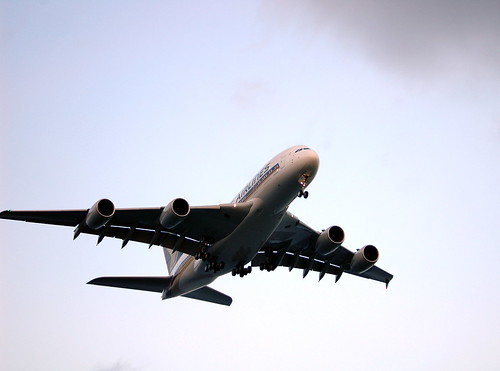
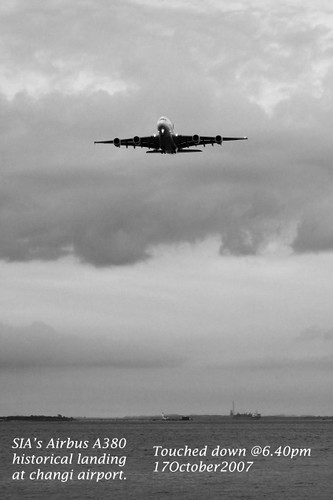
SQ A380 landed in Singapore

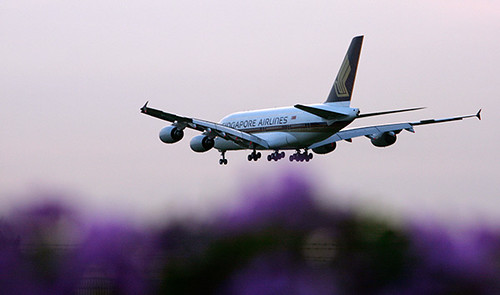
Just a few minutes ago, the first commercial Airbus A380 touched down at Singapore Changi Airport and parked at Terminal 3.

The 471-seater Singapore Airlines A380 (A380-841, MSN003, 9V–SKA, has been previously F-WWSA) arrived from Toulouse, where it had been formally delivered to SIA on Monday in a grand ceremony.

Some 400 guests, including Singapore’s Prime Minister were on hand to welcome the A380 and its crew after the 12-hour flight.
Many more excited people lined the beach off the Airport to witness the new pride of Singapore Airlines making its way to its new home.

Videos I found on YouTube:

Officially news coverage

A380 greeted with water canon salute

Flickr photos by various photographers

a380 singapore

a380 singapore

a380 singapore

Source: Channel NewsAsia

Jet Airways completes order for 20 737s

Boeing and Mumbai-based Jet Airways, India’s largest private airline, today announced they have finalized an order for 20 Next-Generation 737-800s. The order is valued at nearly $1.5 billion at current list prices.
“Today’s announcement reflects our continuing efforts to be the industry leader by combining superior service with reliable, comfortable and efficient operations,” said Naresh Goyal, chairman of Jet Airways. “The 737 has proved to be a reliable and efficient aircraft on our network and has provided economic value for our airline and comfortable travel for our passengers.”
All 20 737-800s will be equipped with performance-enhancing Blended Winglets, which improve fuel efficiency and reduce CO2 emissions by up to 4 percent. Jet Airways currently operates a fleet of 50 Classic and Next-Generation Boeing 737-400/-700/-800/-900 airplanes.
“Since Jet Airways began operations in 1993, the airline has continued to offer its passengers value by adding routes and frequencies while providing a positive flying experience for its customers,” said Dinesh Keskar, Boeing Commercial Airplanes vice president of Sales. “This order validates the superior economics the 737 offers and we value Jet Airways’ continuing endorsement of Boeing jetliners.”
Jet Airways has one of the youngest aircraft fleets in the world, with an average fleet age of just under five years. The airline operates more than 340 daily flights to 53 destinations throughout India and internationally, including the United States, Canada, Belgium, United Kingdom, Singapore, Malaysia, Sri Lanka, Thailand and Katmandu.

VistaJet orders 3 Airbus Corporate Jetliners

VistaJet, the Swiss-headquartered VIP charter company with operations in Austria, Germany and soon in Asia, has ordered 3 Airbus Corporate Jetliners (ACJs), becoming a new customer.

With the acquisition of these three Airbus ACJs, VistaJet will expand its fleet to a total of 31 aircraft, including those on order. The Airbus ACJs will become VistaJet’s flagship aircraft, will all have the same highest standards of configuration and services, and will all be offered for charter through its innovative concept.

VistaJet has yet to select the engines that will power its Airbus ACJs and the cabin completion centre that will outfit them.

“We see increasing demand for top-of-the-line corporate jets, such as the Airbus ACJ, as our “blue-chip” clients realise just how much more comfort and space they can get for their money,” says VistaJet CEO and President Bing Chen. “As a leader in the European and Russian market, we differentiate ourselves by providing the utmost in service with a fleet that is just two years old on average, and which the Airbus ACJs will help us to expand in Russia and Asia. This investment is a further commitment of VistaJet to satisfy the most demanding customers,” he adds.

Airbus’ ACJ Family is increasingly successful, and often serves as the benchmark at the top-end of top-end corporate jets.

“Airbus ACJs are the newest addition to the fast-growing VistaJet fleet that already comprises medium to ultra-long range business jets, some of which are managed for private customers, so it’s good to know that we have been selected by a company that knows its aircraft,” says Airbus Chief Operating Officer, Customers, John Leahy.

Airbus Corporate Jetliners are the first business jets to feature fly-by-wire controls – now the industry standard – and deliver all of the benefits that flow from being a modern design. These include advanced fuel-saving aerodynamics, industry-leading use of weight-saving composites, proven reliability and cost-saving centralised maintenance for all aircraft systems.

Total sales of the Airbus ACJ Family, which comprises the A318 Elite, Airbus ACJ and A320 Prestige, now stand at more than 100 aircraft. The family is derived from the tremendously popular Airbus A320 Family, which has won more than 5,300 orders and has some 250 customers and operators to its credit.

Airbus delivers first A380 to Singapore Airlines

Airbus A380 First Delivery Ceremony

This is a historical day in aviation! Today Airbus has officially handed over the first A380 (A380-841, MSN003, 9V–SKA, has been previously F-WWSA) to Singapore Airlines in a ceremony held at its Delivery Centre Toulouse, France in the presence of over 500 guests. The aircraft was officially handed over to Chew Choon Seng, Chief Executive Officer (CEO) of Singapore Airlines by Airbus President and Chief Executive Officer Tom Enders in presence of Chief Executive Officer Rolls-Royce Sir John Rose. Singapore Airlines will be the first to fly the A380 on regular scheduled service.

For all who missed the ceremony will be photos and videos made available at http://www.a380delivery.com.

Singapore Airlines also used this opportunity to reveal their new, spacious and luxurious A380-cabin-interior, featuring 471 seats in three classes.

“This delivery really marks the beginning of a new chapter for the aviation industry and we feel honoured to be the ones opening this new chapter”, said Chew Choon Seng, Chief Executive Officer of Singapore Airlines. “With the A380, but also with the new cabin we are offering, our customers will enjoy a completely new way of flying while benefiting from the quietest cabin in the sky. In every class we’ll provide more comfort and more space for relaxation. Our new Singapore Airlines Suites – a class beyond First – will redefine luxury air travel,” he added.

You might want to watch this 2 videos.
Singapore Airlines CEO Chew Choon Seng takes the CEOs of Airbus and Rolls Royce on a tour of its first Airbus A380.

Singapore Airlines Airbus A380 advertising.

“This is a landmark day for all those who worked so hard over the years to make it happen. It is also a tribute to all the engineers and workers who developed the A380, as well as all our customers who selected this magnificent and highly efficient jetliner. We appreciate the confidence they have shown in Airbus and for staying with us through troubled times”, said Airbus President and CEO Tom Enders. “This is all a testimony to their faith in the product and in Airbus. We are especially thankful and proud that an airline of the standing and reputation of Singapore Airlines is the first to operate this all new greener, cleaner, quieter and smarter 21st Century Flagship.”

Singapore’s A380 is powered by four Rolls-Royce Trent 900 engines, which generate 72,000 lbs thrust each. They greatly contribute to the A380’s environmental friendliness. As a result the A380 is setting new environmental benchmarks in air-transport. The A380 has an unmatched fuel efficiency of less than three litres per passenger per 100 kilometres.

“We are delighted that Singapore Airlines, our long standing partner, has selected the Trent 900 engine for its A380 long-haul fleet”, said Sir John Rose, Chief Executive, Rolls-Royce. “It’s the quietest and cleanest engine for the A380, with emissions levels well within the requirements of all current and future legislation.”

The aircraft’s efficiency and advanced technologies results in higher operational flexibility and outstanding economics – with a range of more than 8,000 nm/15,000 km and seat-mile costs 20 percent lower than the former largest aircraft.

The A380 will take-off for Singapore on 16th October, arriving at Singapore’s Changi International Airport the following day. The next generation, eco-efficient double-decker will enter service between Singapore and Sydney, with a special charity-flight, between both cities on 25/26th October. The scheduled services will commence daily from 28th October.

Currently Singapore Airlines has five A340-500 Airbus aircraft in its mainline fleet. In total and to date, Singapore Airlines has further 19 A380, 20 A350 and 19 A330-300 on order.

To date, total orders and commitments for the A380 are 189 from 16 customers. Subsequent aircraft for delivery to Singapore Airlines, Emirates Airlines and Qantas are also well on track.

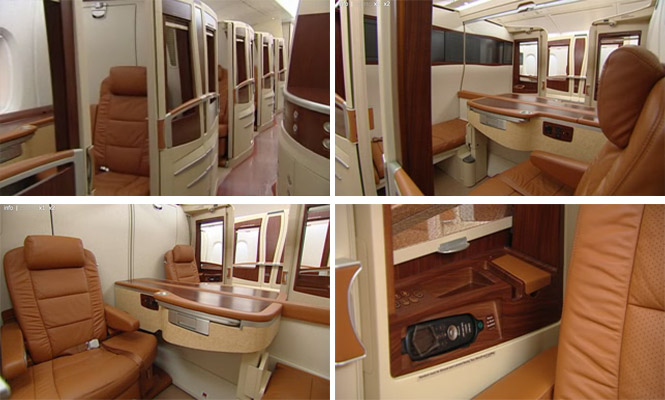
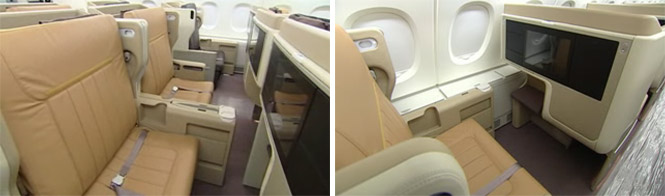
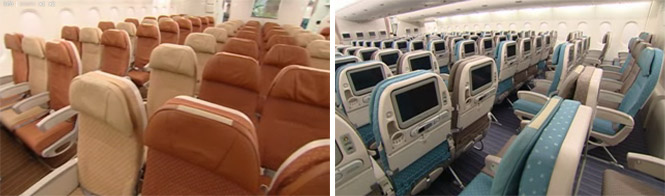
SIA A380 Cabin Interior Revealed – Pictures

The cabin interior of the Singapore Airlines Airbus A380 has been revealed by Airbus. Following you will find pictures of all 3 classes – Singapore Airlines Suites, Business Class and Economy Class. (More information about the cabin layout)

Singapore Airlines Suites

Singapore Airlines A380 SkySuite

Business Class

Singapore Airlines A380 Business Class

Economy Class

Singapore Airlines A380 Economy Class

Visit http://www.a380delivery.com for more great coverage!

A380 Delivery Ceremony on Monday

Airbus A380 First Delivery Ceremony

Airbus will celebrate the first A380-handover to first customer Singapore Airlines on Monday, 15th October, with a dedicated delivery ceremony from 10.00 to 11.30 am CET (Central European Time). The exclusive event – hosted by Singapore Airlines, Rolls-Royce and Airbus – will take place at the Airbus Delivery Centre in Toulouse (France). The spacious double-decker aircraft is powered by four Rolls-Royce Trent 900 engines.

With http://www.a380delivery.com Airbus has set up a dedicated website to follow this historical event. Featured on this website are also articles and great pictures and videos. Don’t miss it!

“This is a major milestone for the A380 programme, and I would like to express my deepest appreciation to all parties concerned. I want to thank our teams and all those who worked hard, days, nights, and week-ends, for their dedication and commitment,” said Tom Enders, Airbus President and Chief Executive Officer.

At the event Singapore Airlines will reveal their new, spacious and luxurious A380 cabin-interior. The flagship of the 21st century will take-off for Singapore on October 16, arriving at Singapore’s Changi International Airport the following day. The next generation, eco-efficient double-decker will enter service between Singapore and Sydney, with a special charity-flight, between both cities on 25/26th October. The scheduled services will commence daily from 28 October.

Being cleaner, greener, quieter and smarter, the A380 is already setting new environmental benchmarks in air-transport. Per passenger, the A380 has an unmatched fuel efficiency of less than three litres per 100 kilometres.

The A380 will provide more comfort in every class and more open space for relaxation. Customers will enjoy a new way of flying while benefiting from the quietest cabin in the sky. The aircraft’s efficiency and advanced technologies will result in higher operational flexibility and outstanding economics – with a range of more than 8,000 nm/ 15,000 km and seat-mile costs 20 percent lower than the former largest aircraft.

To date, total orders and commitments for the A380 are 189 from 16 customers. Subsequent aircraft for delivery to Singapore Airlines, Emirates Airlines and Qantas are also well on track.
The ceremony can be viewed via Live video stream on www.airbus.com, www.a380delivery.com and will also be available for TV satellite downlink free of charge.

The entire ceremony will be retransmitted via three satellites, covering Europe, the Middle-East, Asia, Australia and America.

1- Transmission hours
15th October 2007
Transmission from 07H20 to 09H45 GMT // from 09H20 to 11H45 CET
Transmission via DVB QPSK 4.2.0

2- Transmission via Eutelsat W3 @ 7° East
Donwlink: 11 043.5 Mhz (bande KU)
Polarisation: Vertical
Symbol Rate: 6.6665
FEC: 7/8

3- Transmission via Asiasat 2 @ 100.5° East
Downlink: 4049.5 Mhz (Bande C)
Polarisation: Vertical
Symbol Rate: 6.6665
FEC: 7/8

4- Transmission via NSS806 @ 319.5° East
Downlink: 4 193.5 Mhz (Bande C)
Polarisation: Linear
Symbol Rate: 6.6665
FEC: 7/8