Airbus A380 continues route proving tours

Airbus’ A380 MSN009 test aircraft, powered by the new Engine Alliance GP7000 engines will embark on a series of four tours as part of its technical route proving. During this certification exercise, which aims at accumulating 150 hours of “typical airline” continuous operation, the A380 will visit destinations in South America, North America, the Middle East and Asia-Pacific.

The A380 will first go to

  • Bogota (Colombia) – 26th and 27th September,

returning to its home base in Toulouse, South West France. It will then fly to the USA, landing at

  • Windsor Locks (Connecticut), Hebron (Kentucky) and San Francisco (California) – 2nd till 5th October

and back to Toulouse. The route proving will continue, flying to

  • Dubai, Melbourne (Australia), Manilla and Luzon (Philippines) and back to Dubai – 8th till 13th October.

The next destinations to be visited are

  • Bogota (Colombia), Vancouver (Canada) and Osaka (Japan) – 15th to 19th October.

During the technical route proving tour, the A380 will demonstrate that it can be turned around under normal airline operating conditions. The same tours were successfully completed by test aircraft powered by Rolls Royce Trent 900 engines in 2006. Tests will cover, amongst other things, checks on standard aircraft maintenance and behavior, as well as typical airport operations and compatibility, confirming the aircraft’s readiness for entry into service. Type certification for the A380 fitted with Engine Alliance GP7000 engines is expected for December 2007.

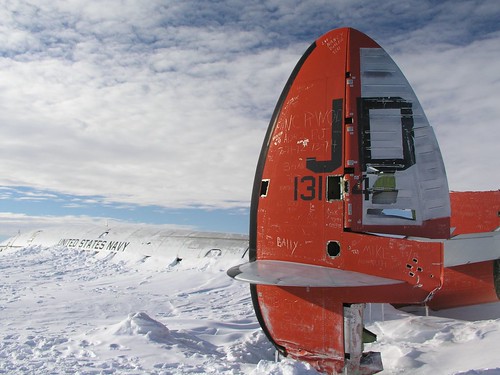
Photo of the Day – Lockheed C-121J Super Constellation resting at Antarctica

Photo via Flickr – by sandwichgirl

tail of super constellellation

Click here to visit the Gallery with all pictures!

On 8 October 1970, this US Navy C-121J Super Constellation (131644/4145) called “Pegasus” crashed into an airfield near McMurdo Station in Antarctica. The flight bound from Christchurch (CHC), New Zealand, to McMurdo Station-Williams Field, Antarctica got into storm blown in from the south that completely eliminated visibility. The flight had already passed PSR (Point of Safe Return), therefore they had no other choice than trying to land, due to lack of fuel to turn around. After circling the runway without getting a visual, they caught a quick glimpse and tried to land. On the second attempt to land the “Connie” was sliding into a heavy snowdrift caused by the storm, separating the right main landing gear. The plane spinned around and the right wing broke off, with the airplane sliding through the snow. Nobody died. Half buried in snow, with a vandalised tail proudly stading high, this piece of history has now become a bit of a local tourist attraction.
Read more at: http://sandwichgirl.livejournal.com/11104.html

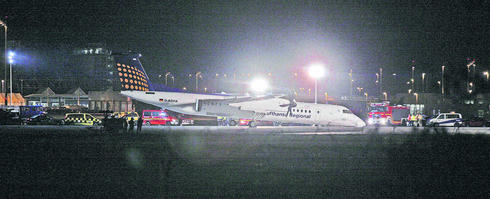
Dash8 Q400 incident at Munich (Picture)

On Friday night, once again a Dash 8-400 (Q400) was involved in a landing-gear-related incident. This was the 3rd accident of a Q400 within only 3 weeks and raises concerns about the safety and a possible design flaw of the Bombardier Q400.

An Augsburg Airways (member of Lufthansa Regional) Dash 8 Q400 originally bound from Munich to Florence (Italy) did an emergency landing at Munich Franz Josef Strauss International Airport (MUC), Germany, after the nose landing gear failed to deploy.

Q400 MUC

During approach to Florence the crew experience difficulties to deploy the nose gear. After trying several times to deploy the front landing gear without avail they decided to return to Munich. Main reason for returning back were security concerns, Munich provides much longer runways than those available in Florence.

After the emergency landing, without nose gear, at MUC the Dash 8 skidded down the runway and came to rest on its nose. None of the 65 passengers and 4 crew members aboard the flight were injured.
The involved Q400 was even inspected last week, with main focus on the landing gear.
Just a few days ago Bombardier announced that approximately 70% of all Q400 worldwide have been returned back to service.

Lufthansa Cargo and DHL Express launch cargo carrier

Deutsche Post World Net and Deutsche Lufthansa AG are founding a joint cargo airline through their subsidiaries DHL Express and Lufthansa Cargo. The new company, based in Leipzig (LEJ), in which DHL Express and Lufthansa Cargo each hold a 50 per-cent stake, will have the legal form of a private limited company (GmbH). It will focus on transporting airfreight and express shipments into and out of Asia. Flight operations are scheduled to begin in April 2009.

The new cargo carrier will initially operate with 11 new Boeing 777-200LRF aircraft. The 777F has a comparable noise footprint to MD-11F but provides 20% higher payload. The aircraft will be leased and are scheduled for delivery from February 2009. The cargo capacities of the new airline will be utilised by Lufthansa Cargo und DHL Express. The two partners will continue to take care of marketing and handling those capacities independently.

Pending the granting of traffic rights, the new airline will gradually expand its route network from the summer schedule 2009. On weekdays, it will be serving Singapore, Bangkok, Dubai, Bombay, Shanghai, Hong Kong, Seoul, Nagoya, Almaty, East Midlands and Milan. At weekends, it will fly to Shanghai, Astana, Singapore, Bangkok, Sharjah, Hong Kong, Chicago and New York.

Aside from pure airfreight traffic, the two companies will each alone be responsible for warehousing and trans-shipment at Leipzig/Halle Airport. DHL Express will handle its express shipments in the newly built cargo centre. Lufthansa Cargo will shortly be building its own modern logistics centre right nearby.

The name of the new company and its branding will be decided at a later date.

UPDATE: The name will be AeroLogic

Source: dpwn

Dash8 Q400 fleet returning to service

After meeting the requirements of Transport Canada’s Airworthiness Directive (AD) related to the recent Bombardier Q400 landing gear issue, operators worldwide have been returning their aircraft to service. Approximately 70% of the Q400 fleet is in service (approximately 116 aircraft out of total fleet of 165 aircraft). Of the estimated 85 Q400 aircraft requiring detailed inspections, more than 35 aircraft are already back in service.

“Several airlines have reported that their Q400 aircraft have returned to normal service. This is excellent news. We expect that more aircraft will also return to service in the coming days. We remain committed to our customers and are providing them with the necessary technical assistance to resolve the issue,” said Steven Ridolfi, President, Bombardier Regional Aircraft.

Bombardier – with the support of Goodrich – continues to focus its efforts on assisting its customers to return to normal flight schedules as quickly as possible.

Source: Bombardier

One-Two-Go MD-82 crashed in Phuket (Video)

A McDonnell Douglas MD-82 (DC-9-82) operated by Thai low budget carrier One-Two-GO (owned by Orient Thai Airways) crashed at Phuket airport in southern Thailand during landing, killing 87 of the 130 people on board, according to health ministry officials.

During heavy monsun rain and heavy crosswinds the pilot attempted to land. The visibility was poor as he decided to make a go-around but the plane lost balance and crashed. The plane skidded off the runway, broke into two and burst into flames.

A spokesman for the airline said the plane was carrying 123 passengers and seven crew members. Many of the 43 survivors were foreigners from Britain, Ireland, Italy, Germany, and Iran.

The island of Phuket is a popular resort destination for international and local tourists.

Two hospital treating survivors detailed their nationalities as: Australian: 1, Austrian: 1, British: 8, Dutch:1, German: 4, Iranian: 3, Irish: 3, Italian: 1, Swedish: 2, Thai: 14.

All flights from Phuket International Airport were canceled following the crash, which TNA reported caused “confusion and anger among travelers concerned to make connections to other destinations and to know when operations will resume.”

Phuket International Airport is the second-busiest airport in Thailand, according to the airport’s Web site. The airport is about 20 miles (32 km) from downtown Phuket.

Videos

Accident Digest

Status: Preliminary
Date: 16 SEP 2007
Time: ca. 16:00
Type: McDonnell Douglas MD-82 (DC-9-82)
Operator: One-Two-Go Airlines
Registration: HS-OMG
C/n / msn: 49183/1129

First flight: 17 November 1983 (TWA – N912TW)
Crew: Fatalities: / Occupants: 7
Passengers: Fatalities: / Occupants: 123
Total: Fatalities: 88 / Occupants: 130
Airplane damage: Written off
Location: Phuket International Airport (HKT) (Thailand) show on map
Phase: Landing
Nature: Domestic Scheduled Passenger
Departure airport: Bangkok-Don Muang International Airport (DMK/VTBD), Thailand
Destination airport: Phuket International Airport (HKT/VTSP), Thailand
Flightnumber: 269
Narrative:
One-Two-Go Flight 269 departed Bangkok-Don Muang (DMK) at about 14:30 for a domestic service to Phuket (HKT). It was raining at Phuket when the MD-82 approached the airport. Wind was from the West at 12 knots.
On landing the airplane went off the side of the runway, crashed into trees and caught fire. Weather around the time of the accident (ca 09:00 Z) was: VTSP 160900Z 27012KT 1000 RA SCT015 BKN110 BKN300 24/23 Q1006 2973.

AIRCRAFT PROFILE MCDONNELL DOUGLAS MD-80
* Last fatal hull-loss accident: 16 AUG 2005 HK-4374X of West Caribbean Airways, near Machiques, Venezuela- 160 fatalities
* Total number of hull-losses: 22 (19 accidents, 3 other occurrences (destroyed on the ground )), of which 12 losses were fatal
* 6th worst accident

AIRPORT PROFILE PHUKET
* ICAO/IATA designators: HKT / VTSP
* Latitude: 08° 06′ 47.52″ N / 029° 14′ 18.47″ E
* Elevation: 82 ft/ 25 m
* Runway: 09/27 (9843 x 148 feet, asphalt, ILS)
* Third hull-loss accident of an airliner at or near Phuket Airport

OPERATOR PROFILE ONE-TWO-GO
Thai low-cost carrier operating out of Bangkok since 2003. It is wholly owned by Orient Thai Airlines.
* First hull-loss accident

COUNTRY PROFILE THAILAND
* Last fatal airliner hull-loss accident: 03 MAR 2001 Boeing 737-4D7 HS-TDC of Thai Airways International, Bangkok International Airport – 1 fatality
* 3rd worst accident in Thailand

Sources:
Accident Digest by Aviation Safety Network
Bangkok Post, CNN

Preliminary Report on Danish SAS Q400 accident

The Danish investigation board has released a preliminary report on the SAS Dash 8-400 (Q400) accident from September 9th at AAL.
Apparently corrosion in the Actuator Piston has been hold responsible for this accident.

Further details:

Technical investigation
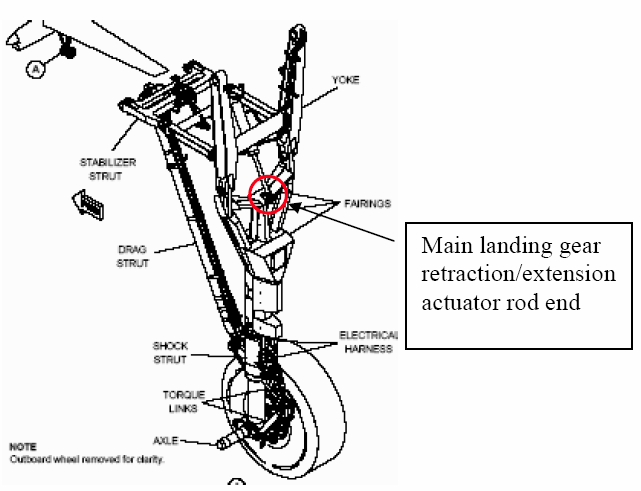
The technical investigation was focused on the right main landing gear assembly. Significant fracture damage to the right main landing gear was observed.

SAS AAL Investigation - Landing Gear

During the investigation, it was observed that the rod end of the right main landing gear retraction/extension actuator had separated from its piston rod.
The main landing gear retraction/extension actuator, the actuator rod end, and stabilizer brace assembly were removed from the aircraft for further examination.
Examination of the internal threads of the retraction/extension actuator piston revealed the presence of corrosion, which led to separation of the rod end from the piston. The separation contributed to the landing gear collapse.
The regulatory authorities were apprised of the situation and have subsequently issued an airworthiness directive which requires immediate action by the operators.
The investigation continues.

History of flight
The accident flight was a scheduled domestic passenger flight from Copenhagen International Airport, Kastrup (EKCH) to Aalborg Airport (EKYT).
The flight from EKCH until the approach to EKYT was uneventful.
On approach to EKYT, the landing gear was selected down. When the landing gear extension sequence was completed, the cockpit indication for the landing gear indicated two green lights and one red light. The two green lights indicated that the left main landing gear and the nose landing gear were down and locked (safe). The red light indicated that the right main landing gear was not locked (unsafe). A go-around was initiated.
An alternate landing gear extension procedure was conducted but the cockpit indication for the right main landing gear remained unsafe.
A visual inspection of the landing gear was performed.
The cabin was prepared for an emergency landing and the passengers were briefed.
The aircraft touched down on the left main landing gear, followed by the right main landing gear, and shortly thereafter the right main landing gear collapsed. The aircraft then departed the runway to the right and came to rest on the lower fuselage and right wing tip.
The aircraft was substantially damaged.
Some passengers sustained minor injuries.
The accident took place during daylight hours and visual meteorological conditions.

Source: hcl.dk