Pilots Forget to Land – Northwest Plane Overshoots Destination

It sounds like a bad joke: Northwest Airlines flight 188 from San Diego (KSAN) to Minneapolis (KMSP) overshot its intended destination by 150 miles on Wednesday evening.

What happened in that cockpit? The pilots say they “lost situational awareness” while arguing about airline policy. The immediate suspicion is that they fell asleep.

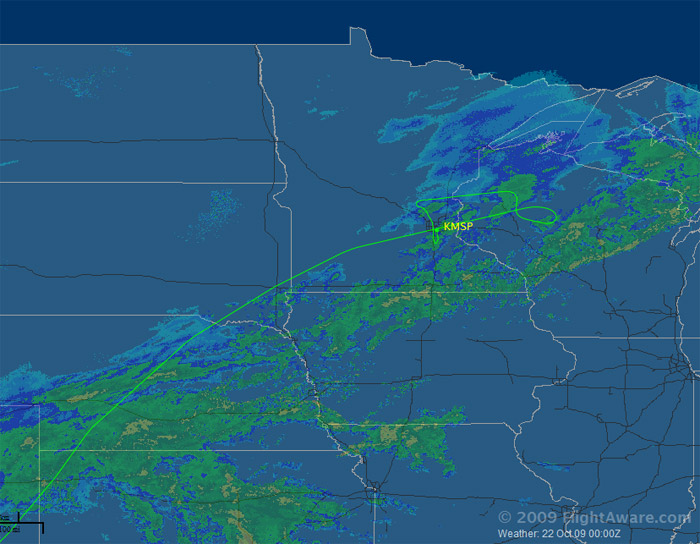
Northwest Airlines Flight 188 Flight Path Map

Contact with the Airbus A320 was lost at about 6:45 p.m. local time, the aircraft overflew Minneapolis and crossed the state line into Wisconsin before the crew responded to ATC and turned back. A review of the cockpit voice recorder is underway and will probably reveal the real cause of this small detour.

Video – Short interview with pilot

Flight 188 at Flightaware:
http://flightaware.com/live/flight/NWA188/history/20091021/2135Z/KSAN/KMSP

Related Link:
http://www.thedailybeast.com/blogs-and-stories/2009-10-22/the-new-cockpit-threat/?cid=hp:mainpromo1

A330 MRTT First Time Boom Refueling of F-16

The EADS A330 Multi-Role Tanker Transport (MRTT) – currently in production for four allied nations – marked another major performance milestone with the first in-flight refueling performed from the Royal Australian Air Force (RAAF) A330 MRTT utilizing its integrated Aerial Refueling Boom System (ARBS).

The contacts and subsequent fuel transfers were made with two F-16 receiver aircraft and validated the advanced ARBS handling qualities, precision, and stability on the A330 MRTT, as well as the capabilities of its 3-D vision system. The flight lasted four hours and 30 minutes, with more than 3,300 pounds of fuel transferred during 13 contacts.
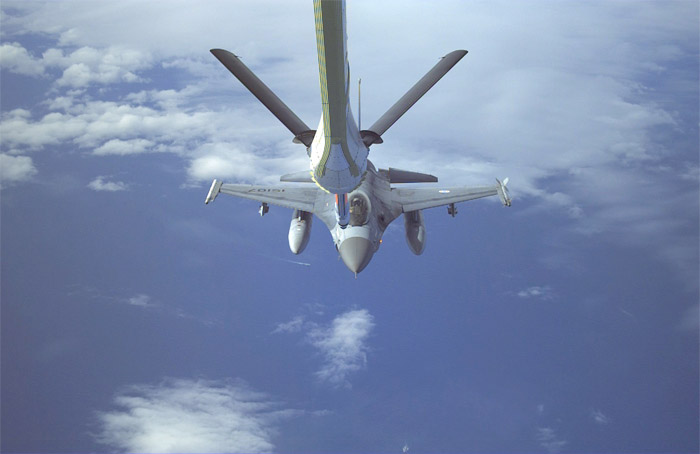
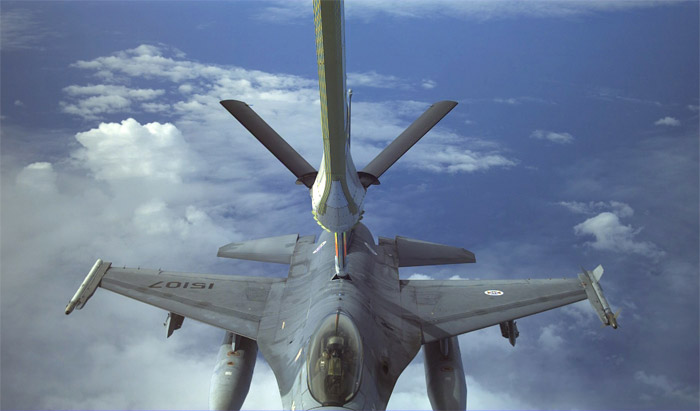
EADS A330 Multi-Role Tanker Transport (MRTT) Boom Refueling
A330 MRTT Tanker Boom Refueling of F-16

EADS’ fly-by-wire ARBS is one of the key technological discriminators for the A330 MRTT and Northrop Grumman’s KC-45 offering to the U.S. Air Force, providing the only digital, all-electric fly-by-wire refueling system available today.

The ARBS has already made more than 250 wet and dry contacts with a wide range of receiver aircraft, in a full range of operating conditions and throughout the flight envelope, while the boom was deployed on an EADS test-bed aircraft.

The RAAF’s A330 MRTT is similar in configuration to Northrop Grumman’s KC-45 Tanker offered for the U.S. Air Force to recapitalize its aging aerial refueling fleet. Both aircraft are equipped with the EADS ARBS, plus a pair of all-digital Cobham 905E refueling pods under the wings. This mix of boom and pod refueling technologies ensures the A330 MRTT and KC-45 can transfer fuel to all types of receiver aircraft during a single mission without reconfiguration. The KC-45 also offers a centerline hose-and-drogue fuselage refueling unit.

The boom’s maximum nominal fuel flow rate is 1,200 U.S. gallons per minute, while the pods can deliver up to 420 gallons of fuel per minute. Aerial refueling operations are controlled from a state-of-the-art Remote Aerial Refueling Operator console in the cockpit behind the pilots, incorporating the enhanced vision system with laser infrared lighting and high-definition digital stereoscopic viewing.

EADS North America is a principal teammate on Northrop Grumman’s KC-45 Tanker program, and is responsible for delivering the aircraft platform, which will be produced at a new aerospace center of excellence to be built in Mobile, Ala.

Airbus Military, an EADS company, is responsible for the design and production of the A330 Multi-Role Tanker Transport for international customers, which today includes Australia, the United Kingdom, Saudi Arabia and the United Arab Emirates. Orders from those countries total 28 aircraft. The A330 MRTT has won all of the international competitions for new-generation aerial tankers since 2004.

The RAAF will receive its first of five A330 MRTTs in 2010, two of which have completed conversion and currently are in flight test. Upon delivery to the RAAF, they will be designated the KC-30A.

Source: EADS
Photos: EADS

Norwegian Air Shuttle Orders Additional Next-Generation 737s

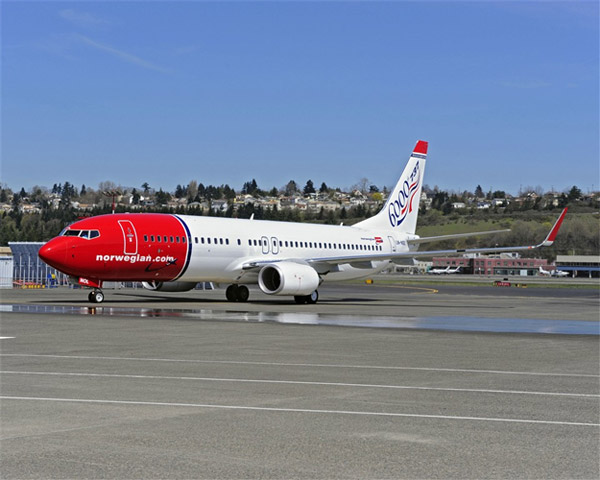
Boeing and low-cost carrier Norwegian Air Shuttle today confirmed an order for additional six Next-Generation 737-800s. With this order, Norwegian has a total of 48 Next-Generation 737 airplanes on order from Boeing as well as 22 airplanes from leasing companies.

The new 737s will feature advanced-technology Blended Winglets, an environmental innovation that reduces drag, resulting in less fuel consumption and a decrease in carbon emissions of 3.5 to 4 percent.

6000th Boeing 737 - Norwegian Air Shuttle ASA (LN-NOL)

The Oslo-based carrier is one of the first airlines in Europe that will incorporate the spacious new 737 Boeing Sky Interior starting at the end of 2010. Inspired by years of design research on the 787 Dreamliner, airlines with this new interior will feature the soft, blue-sky-like lighting overhead, contemporary sculpted sidewalls and window reveals designed to draw passengers’ eyes to the airplanes’ windows, enhancing the passengers’ overall flying experience.

Norwegian’s aircrafts are equipped with state-of-the-art Recaro seats which offer increased legroom without compromising capacity. Norwegian has opted for a 186-seat configuration in its aircraft contrary to a full capacity 189-seat configuration.

Source: Boeing
Photo: Boeing

Boeing 707 Crashed in Sharjah United Arab Emirates

Today a Sudan Airways Boeing 707-300 cargo plane crashed shortly after take-off from Sharjah Airport (SHJ/OMSJ), United Arab Emirates. The Boeing was leased from AZZA Transport and operated as flight SUD2241, bound for Khartoum (KRT/HSSS), Sudan.
The plane crashed near a road, broke up and burned. No one of the 6 crew on board survived.

Videos

News story & photos at http://gulfnews.com/news/gulf/uae/emergencies/six-dead-after-…

Cathay Pacific 777-300ER in Oneworld Livery Delivered

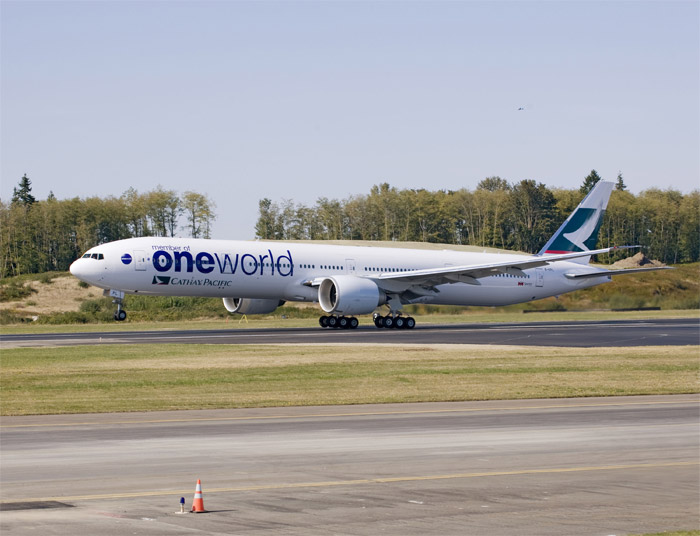
Boeing recently delivered a 777-300ER (Extended Range) to Singapore-based leasing company BOC Aviation and its customer, Cathay Pacific Airways. The airplane is painted in a special oneworld livery to highlight the commitment of Cathay Pacific, as a member airline, to the alliance’s 10th anniversary.

Cathay Pacific Boeing 777-300ER in Oneworld Livery

The airplane (B-KPL) is the 12th Boeing 777-300ER for Cathay Pacific and brings the airline’s 777 fleet to 29 airplanes, which includes 12 777-300s and five 777-200s. The airline also operates 22 Boeing 747-400 passenger airplanes.

The oneworld alliance has 10 member airlines and 17 affiliate airlines, serving 134 countries and 673 destinations, with 8,400 daily departures. Full oneworld alliance members are American Airlines, British Airways, Cathay Pacific, Qantas, Finnair, Iberia, LAN, Japan Airlines, Malév, Royal Jordanian.

Source: Boeing
Photo: Boeing

E-2D Advanced Hawkeye Completes First Catapult launch tests

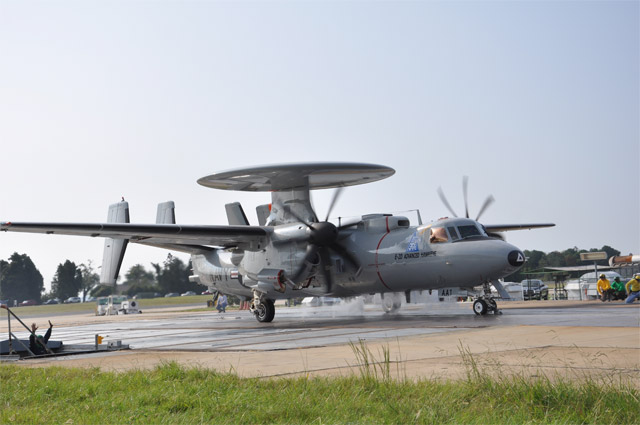
In preparation for its Initial Operational Test and Evaluation (IOT&E), Northrop Grumman’s first E-2D Advanced Hawkeye test aircraft, known as Delta One, has successfully completed its first land-based catapult launch tests. Both E-2D System Development and Demonstration (SDD) aircraft, Delta One and Delta Two, are currently undergoing shore-based carrier suitability testing at Naval Air Station Patuxent River, Md., conducted by the U.S. Navy’s Air Test and Evaluation Squadron 20 (VX-20).

Prior to joining the carrier fleet, all naval aviation aircraft undergo carrier suitability testing. The bulk of this testing involves catapult and arrested landing structural tests, as well as the interoperability between the aircraft and the carrier.

Northrop Grumman E-2D Advanced Hawkeye Delta One

Introduced in 2007, and built on the E-2’s strong legacy of providing world-class airborne early warning and control (AEW&C) capability for more than 45 years, the E-2D Advanced Hawkeye is the sixth generation of the E-2. While its external appearance is similar to the E-2C, the internal systems of the Advanced Hawkeye have been completely redesigned and the capabilities vastly expanded. With its newly developed, more powerful AN/APY-9 Electronic Scan Array (ESA) radar, the E-2D will provide the warfighter with the expanded battlespace and situational awareness required for today’s and tomorrow’s missions.

Under a $408 million contract awarded in July 2007, Northrop Grumman is producing three E-2D pilot production aircraft which are on-track for delivery to the U.S. Navy in 2010. Following the successful completion of a Milestone C review, a $432 million contract, awarded in June, kicked off Low-Rate Initial Production. The Navy’s Program of Record is for 75 total E-2D Advanced Hawkeye aircraft.

Source: Northrop Grumman
Photo: Northrop Grumman

FAA Proposes Fine Against US Airways and United Airlines

The Federal Aviation Administration (FAA) today proposed fines against US Airways and United Airlines because of violating maintenance procedures and operating airplanes in unsafe conditions.

US Airways is fined a $5.4 million civil penalty for allegedly operating eight aircraft on a total of 1,647 flights from October 2008 to January 2009 while not in compliance with certain Airworthiness Directives (ADs) or the airline’s maintenance program. ADs are rules issued by the FAA when an unsafe condition exists on a type of aircraft, and additional maintenance is required to remedy the problem.

The FAA found the following issues:

  • The airline operated one Embraer 190 aircraft on 19 flights from October 22, 2008 to October 26, 2008 while the aircraft was not in compliance with an AD that required inspections to prevent a cargo door from opening during flight.
  • The airline failed to perform inspections required by an AD for cracking of a landing gear part on one Airbus A320. The airline operated the aircraft on 26 flights from November 2, 2008 to January 20, 2009 while not in compliance with the AD. The airline also operated another A320 for 17 flights from December 3, 2008 to January 21, 2009 while not in compliance with the same AD.

The FAA found the following problems with maintenance practices:

  • US Airways failed to meet the requirements of its Maintenance Policies and Procedures Manual, which required inspections related to engine work on a Boeing 757 aircraft. The airplane was flown on 505 flights from May 2, 2008 to December 3, 2008.
  • From October 20, 2008 to November 14, 2008, US Airways operated one Boeing 767 aircraft on 51 flights after failing to perform the inspections, tests, and samplings required by its maintenance program on that aircraft.
  • From October 1, 2008 to November 24, 2008, US Airways operated one Boeing 757 aircraft on 121 flights without proper maintenance.
  • The airline failed to follow its maintenance program and perform a weekly maintenance check for one Boeing 767 aircraft, which was then operated from November 2, 2008 to November 6, 2008 on 53 flights.
  • From May 22, 2008 to January 13, 2009, US Airways operated one Airbus A320 aircraft on 855 flights while the aircraft did not meet the airline’s maintenance program requirements for an engine repair. US Airways could have deferred maintenance of this item for ten days under its maintenance program but failed to do so. Fifty-one of the flights occurred after the FAA, on December 31, 2008, brought the problem to the airline’s attention.

United Airlines was fined a $3.8 million civil penalty for allegedly operating one of its Boeing 737 aircraft on more than 200 flights after the carrier had violated its own maintenance procedures on one of the plane’s engines.

On April 28, 2008, a United 737 returned to Denver after shutting down an engine due to low oil pressure indications. During teardown of the engine a week later, United mechanics found that two shop towels, instead of required protective caps, had been used to cover openings in the oil sump area when maintenance was done in December 2007. As a result of United’s failure to follow its maintenance procedures, between February 10 and April 28, 2008 it flew the aircraft on more than 200 revenue flights when it was not in an airworthy condition.
United’s maintenance procedures specifically require use of protective caps or covers on all components that could be adversely affected by entry of foreign materials.

Both airlines have 30 days to respond to the FAA.

Source: FAA

Boeing AH-6i Makes First Flight

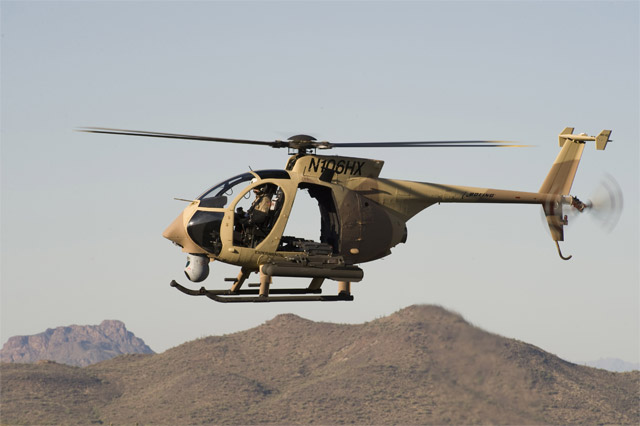
Boeing today announced that the AH-6i light attack/reconnaissance helicopter successfully completed its first flight on Sept. 16, seven months after the company started work on the prototype aircraft.

During the 36-minute flight at the Boeing Rotorcraft Systems facility in Mesa, Ariz., the helicopter demonstrated its flight characteristics and several handling maneuvers.

Boeing AH-6i

Speaking today at the Association of the United States Army (AUSA) Annual Meeting and Exposition, Al Winn, Boeing vice president of Apache Programs, said that Boeing experimental test pilots have subsequently flown the helicopter over the Arizona desert on multiple occasions as they test the platform’s capabilities.

The AH-6i program, launched by Boeing at the 2008 AUSA meeting, is intended for international customers. The AH-6i features flexible mission configuration, an integrated digital cockpit, combat-proven design, the highest payload in its class, an integrated and qualified weapons system, and a communications package that enables connectivity with other aircraft and ground stations.
The AH-6 is based on the civilian MD 530F.

Boeing will produce the AH-6i at its facility in Mesa and is responding to inquiries from potential customers around the world.

Source: Boeing
Photo: Boeing

Malaysia Airlines B737 Gear Collapse at Kuching

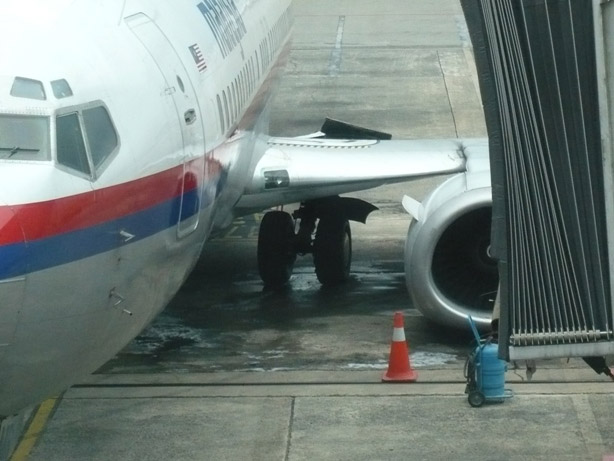
Malaysia Airlines Boeing 737-400 9M-MMR sustained substantial damage as the left main gear collapsed at the gate at Kuching (KCH), Malaysia. The wing was punctured by the undercarriage leg and the left engine contacted the ground.

Source: aviation-safety.net
Photo: miricommunity.net user “avantgarde”