787 Dreamliner First Flight and Delivery Delayed Again

Boeing today announced an updated schedule for its all-new 787 Dreamliner program that moves the commercial jet’s first flight into the second quarter of 2009 and first delivery into the first quarter of 2010. The new schedule reflects the impact of disruption caused by the recent Machinists’ strike along with the requirement to replace certain fasteners in early production airplanes.

“Our industry team has made progress with structural testing, systems hardware qualification, and production, but we must adjust our schedule for these two unexpected disruptions,” said Boeing Commercial Airplanes President and CEO Scott Carson.
Prior to the strike that halted much of the company’s commercial airplane work from early September into November, the 787 was to make its first flight late in the fourth quarter of 2008. First delivery was slated for the third quarter of 2009.
“We’re laser focused on what needs to be done to prepare for first flight,” said Pat Shanahan, 787 program vice president. “We will overcome this set of circumstances as we have others in the past, and we understand clearly what needs to be done moving forward.”
Included in the preparations for first flight, Shanahan said, are finalizing and incorporating remaining engineering changes and completing systems testing, qualifications and certification.
Boeing is evaluating the specific impact of this delay on customer delivery dates and will provide customers with updated schedules once completed. The company is also determining any financial impact from this schedule change and will incorporate that into updated financial and overall airplane delivery guidance that will be released at a later date.
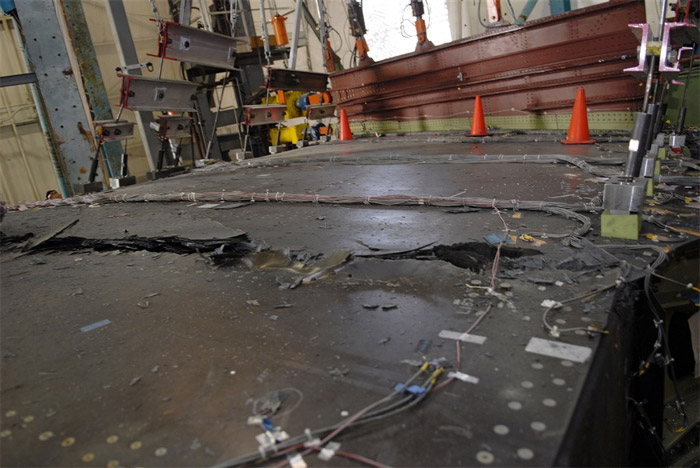

787 Dreamliner – Destructive Testing on Wing Box Completed

Boeing completed destructive testing on a full-scale composite wing box of the 787 Dreamliner, the first all-composite wing box ever built for a Boeing commercial airplane. This test is part of the certification process for the all-new jetliner.

The wing box is a cantilevered beam that carries the wing to the fuselage and supports leading- and trailing-edge devices, control surfaces, engines and landing gear. The test piece represents a portion of the wing section that begins at about the center of the airplane and stops at approximately one-half of the span of the wing – approximately 50 feet (15.2 meters). The piece measures approximately 18 feet (5.5 meters) at its widest point.

Boeing 787 Dreamliner Wing Box Destructive Testing

The upper and lower surface panels and the spars of the wing are made entirely of the same composite material being used on the fuselage. The wing ribs are monolithic aluminum structures, each machined from a single piece of aluminum plate.

To meet certification requirements, the wings must withstand loads up to 1.5 times, or 150 percent, of the highest aerodynamic load that the jet could ever be expected to see in the entire lifetime of the 787 fleet.
The test wing box weighs 55,000 pounds, including a great deal of test-only hardware and instrumentation. It was designed and built by a joint team of Boeing, Mitsubishi Heavy Industries and Fuji Heavy Industries.

Structural testing will continue on two full-scale 787 airframes as part of the certification process for the airplane. Those tests will further demonstrate the performance of the structure through multiple lifetimes of normal operational loads and test the structure beyond the points expected to be seen in service.

Video: http://787milestones.tpninteractive.com/

Source: Boeing
Photo: Boeing

Update On Boeing 747-8 Program

Boeing LogoBoeing today announced an adjusted schedule for production and delivery of the 747-8 Freighter and Intercontinental airplanes.
The revised schedule is based on a production and flight-test plan developed in conjunction with the company’s suppliers that provides additional time for addressing issues that have slowed the program’s progress. Those issues include supply chain delays driven by design changes to the airplane, limited availability of engineering resources inside Boeing, and the recent Machinists’ strike that halted production in the company’s factories.

  • Delivery of the first 747-8 Freighter will move from late 2009 to the third quarter of 2010.
  • The first 747-8 Intercontinental passenger jet delivery moves from late 2010 to the second quarter of 2011.

“Our entire team has worked hard to mitigate growing schedule risk on this program but have been unable to overcome the collective impact of work statement increases to the original design, a tight supply of engineering resources, and the recent Machinists’ strike,” said Boeing Commercial Airplanes President and CEO Scott Carson. “We are clearly disappointed in what this schedule change means for our customers, employees, suppliers and other stakeholders. However, it is the appropriate and prudent decision to ensure a successful program, and we are committed to working with our customers to mitigate any disruption it causes them.”
The revised schedule is the result of a comprehensive assessment of the production system and flight-test plan that began in late August and concluded with the incorporation of the impact of the recent strike.
“The remaining work on the 747-8 program is well defined,” said Ross R. Bogue, vice president and general manager — 747 Program and Everett site. “This schedule adjustment provides the time we need to finish that work and bring both airplanes to market successfully for our customers.”
The risk of a schedule adjustment on the program was previously identified and was provisioned for in Boeing’s third quarter financial results. The company will provide updated financial guidance and a post-strike assessment of the schedule for all its commercial airplane programs at a later date.

Source: Boeing

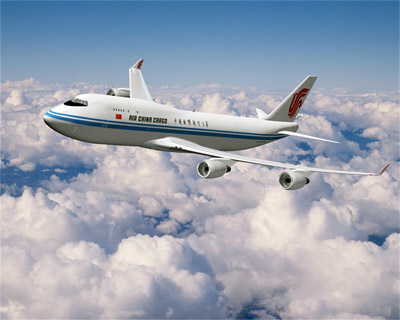
Air China Cargo orders 3 747-400 BCF

Boeing and Air China Cargo today announced that the carrier will add 3 747-400 Boeing Converted Freighters (BCF) to its cargo fleet.
The modification work on the three Combi airplanes will take place at Taikoo Aircraft Engineering (TAECO) in Xiamen, China. They previously were operated by Air China.

“We look forward to our Boeing 747-400BCFs being of the same high quality as the factory-built freighters we operate,” said Air China Cargo President Yao Jun. “Since Boeing is responsible for the modification, we know that these airplanes will receive the superior customer support that we have come to expect from Boeing.”
Air China Cargo Boeing 747-400 Boeing Converted Freighters (BCF)
Air China Cargo currently operates eight freighters, including three 747-400 Freighters delivered new in 2005, 2006 and 2008, as well as two other 747-400 Freighters on lease and three 747-200 Freighters.
“The 747-400 Boeing Converted Freighter provides an economical solution for Air China Cargo to profitably grow its business,” said Dan da Silva, vice president of Sales for Boeing Commercial Aviation Services. “Air China Cargo recognizes, as does the world, the superior reliability, efficiency and value of the 747-400 Boeing Converted Freighter.”

Modifications include a side cargo door addition, a strengthened main-deck floor, full main-deck lining installation, provisions for a new cargo handling system and complete revisions to the airplane systems. The 747-400BCF has positions for 30 pallets on the main deck – volume which is comparable to the 747-400 production freighter.

Air China Cargo, which was formed in late 2003, provides cargo services to 36 cities in 27 countries around the world.

Source: Boeing
Photo: Boeing

Rollout of first F-15SG to Singapore

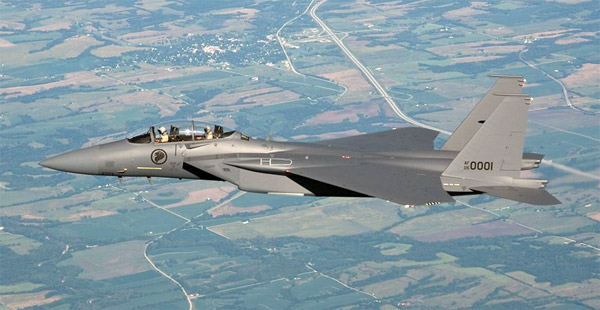
Boeing today rolled out the first F-15SG jet fighter to the Republic of Singapore Air Force (RSAF). The F-15SG is a variant of the F-15E.

“The rollout of F-15SG1, on schedule, demonstrates that we’re off to a great start as the RSAF builds to a procurement of 24 F-15SG aircraft,” said Mark Bass, Boeing F-15 Program vice president. “The F-15SG has significant capabilities that will allow the RSAF to expand into new missions with new capabilities and to operate in the sophisticated Singapore defense environment for decades to come.”
The capabilities of the F-15SG are a blend of speed, power and agility – a combination that makes the aircraft the ultimate multirole fighter, versatile in all missions.
“The F-15SG for Singapore moves the RSAF into the next generation of fighter aircraft capability,” said Dan Korte, Boeing vice president and general manager for Global Strike Systems. “We are proud that the F-15 Eagle’s proven legacy and Boeing’s expertise in multirole fighter aircraft continue in the capable hands of the RSAF.”

Singapore Air Force (RSAF) F-15SG

The F-15SG’s integrated sensor suite, which includes an Active Electronically Scanned Array (AESA) radar and a third-generation SNIPER targeting pod, will provide the RSAF with long-range air-to-air and air-to-ground capabilities.

F-15SG1 successfully completed its first flight from Lambert International Airport in St. Louis on Sept. 16. The aircraft now will undergo a one-year flight test program to confirm aircraft performance. Flight testing will take place at Boeing facilities in St. Louis and in Palmdale, Calif. F-15SG production deliveries will begin in the second quarter of 2009. The final aircraft in this procurement will be delivered to the RSAF in 2012.

Source: Boeing
Photo: Boeing

Stunning Photo – EVA Air Boeing 747 taking off from Amsterdam – Schiphol

Today I came across of some amazing photo at Flickr. It’s showing an EVA Air Boeing 747-45EM taking off from runway 36L at Amsterdam – Schiphol (AMS / EHAM) (Netherlands). The great timing and angle just makes this shot, and the size of the 747, looking quite surreal. Just amazing if you ask me!

VA Air Boeing 747 taking off from Amsterdam - Schiphol
(Click for full size)

All credits go to Flickr User “Points1“. Visit his photo page to leave comments.

Boeing – New AH-6 Program

(Boeing) Boeing today announced a new rotorcraft program, the AH-6 light attack/reconnaissance helicopter.
Designed on a combat-proven platform with a heritage of successful service with U.S. Army Special Operations, the AH-6 is designed to meet the current requirements of international military customers while maintaining flexibility for future growth.

“Boeing has been approached by several potential customers seeking light attack and reconnaissance capabilities in a flexible rotorcraft platform,” Dave Palm, director of Boeing Rotorcraft Business Development, said today at the Association of the United States Army’s annual convention in Washington, D.C. “We believe this system is a perfect fit for those customers seeking long endurance, proven performance and 2,000-pound payload within an affordable helicopter.”

The AH-6 features an Electro-Optical/Infrared forward-looking sight system as well as a mount for weapons that have been qualified on the aircraft, including Hellfire missiles, the M260 seven-shot rocket pod, a machine gun and a mini-gun integrated with a sensor system. A communications package allows the AH-6 to connect to other aircraft and to ground stations.

Boeing will produce the AH-6 at its Rotorcraft Systems facility in Mesa, Ariz., and will draw on that organization’s existing secure supply base to ensure on-time, on-cost delivery.

Source: Boeing

NATO Consortium to buy Boeing C-17s

Boeing today announced that an international consortium of 10 NATO members – joined by Partnership for Peace nations Sweden and Finland – signed a Memorandum of Understanding (MOU) on Sept. 24 to acquire three Boeing C-17 Globemaster III long-range cargo jets. The agreement sets the stage for NATO’s first major defense purchase in 30 years.
Under the agreement with the U.S. Department of Defense and the NATO Airlift Management Agency, two of the advanced airlifters would be purchased from Boeing, while a third would be provided by the U.S. Air Force. The aircraft would be assigned to NATO’s Heavy Airlift Wing and jointly operated by the nations from Pápa Air Base, Hungary. Delivery of the first aircraft could take place as early as spring 2009.
Each participating nation would pay for a portion of a C-17 rather than an entire aircraft, allowing them to share a pooled fleet. The 12 countries participating in NATO’s Strategic Airlift Capability (SAC) program are Bulgaria, Estonia, Finland, Hungary, Lithuania, the Netherlands, Norway, Poland, Romania, Slovenia, Sweden and the United States.

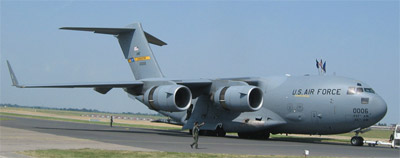
Boeing C-17 Globemaster III

The C-17 fleet will allow each nation to meet its airlift requirements to support sovereign and multinational mission requirements. NATO does not currently own a heavy airlift capability and frequently contracts with nations such as the United States and Russia for assistance with its heavy airlift requirements. The MOU calls for Boeing to establish a facility at Pápa Air Base to provide C-17 logistics support under the current Globemaster Support Partnership.

There are 192 operational C-17s worldwide – 178 with the U.S. Air Force; six with the Royal Air Force (UK); four with the Royal Australian Air Force, and four with the Canadian Forces. Boeing received a contract in July to provide the C-17 to Qatar, with deliveries starting in late summer 2009.

Source: Boeing
Photo: Flightstory.net

Boeing 787 Static Airframe Complete First Test

Boeing successfully completed a high-pressure test, known as “high blow,” on the 787 Dreamliner static test airframe at its Everett factory on Saturday. The test is one of three static tests that must be cleared prior to first flight. During the test, the airframe reached an internal pressure of 150 percent of the maximum levels expected to be seen in service – 14.9 lbs. per square inch (1.05 kilograms per centimeter) gauge (psig). It took nearly two hours to complete the test, as pressure was slowly increased to ensure the integrity of the airplane.

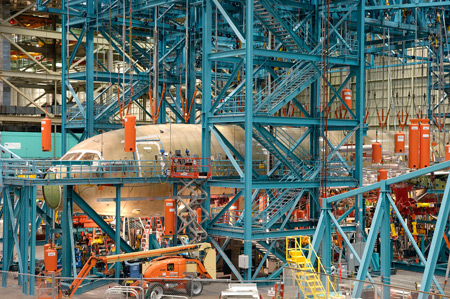
Boeing 787 Dreamliner static test

“We had every confidence going into this test because of the extensive work we’ve done on larger and larger pieces of composite – from small coupons to fuselage sections,” said Pat Shanahan, vice president and general manager of the 787 program. “Still, it’s very rewarding to see a whole airplane being tested and having the results we expected.
“I am so proud of the team that has worked on this program and the progress we are making.”

Photo: Boeing
Source: Boeing

Jumbo Hostel to open at Stockholm-Arlanda Airport

Have you ever dreamed of living in an airliner? Soon you can book your own room in the world’s first Jumbo Hostel, located at Stockholm International Airport, Stockholm-Arlanda (ARN), Sweden.

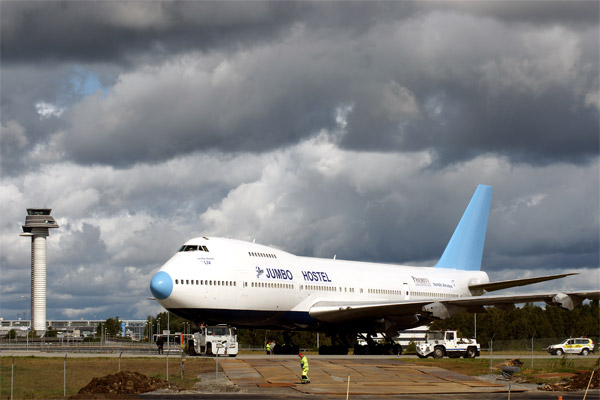
Jumbo Hostel Stockholm-Arlanda Sweden

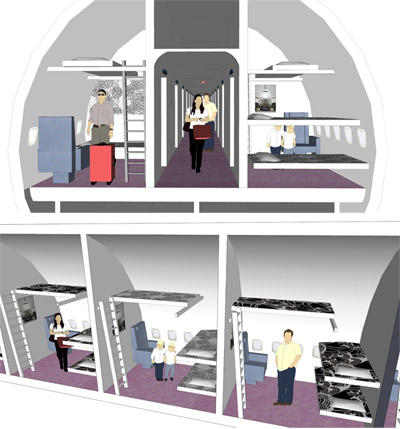
The Boeing 747-200 at last operated by Transjet offers 25 rooms with 85 beds in total. One highlight will be the Cockpit Suite – the cockpit has been converted into a deluxe suite with parts of the original interior saved.

Jumbo Hostel Stockholm-Arlanda Sweden

Bookings will start in December. Visit http://www.jumbohostel.com